Chicago neighborhoods that have experienced disinvestment don’t need saviors to recover
Published on Jan. 27, 2017 by Lynda Lopez
The title of Claiming Neighborhood hooks you, challenging the reader to interpret what that even means. Much like its title, John J. Betancur and Janet Smith, professors at the University of Illinois at Chicago’s urban planning college, want us to explore how neighborhoods change in Chicago and elsewhere. Rather than viewing neighborhood change as normal and natural, the authors want us to think about the nuances of the dynamics that shape the places we live.
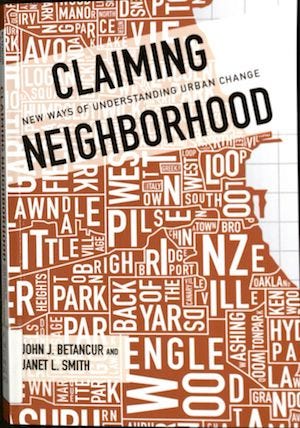
Going into this book, I thought it would be solely about gentrification and the way it happens across a city. However, “gentrification” is seldom used, likely purposefully. The authors want the reader to rethink the idea that neighborhoods can be easily summed up in a phrase. If we don’t truly understand the process by which neighborhoods change, the words we apply to neighborhoods mean nothing.
Neighborhoods don’t develop as organically as we may think
Neighborhoods don’t happen by accident, a point emphasized throughout. Case in point is the construction of Pilsen and Bronzeville into the “Black Mecca” and Pilsen into the center of Mexican culture. Both neighborhoods took on those perceptions due to the migration of Black Americans into Bronzeville and Mexican immigrants into Pilsen. In addition to having been shaped by shifting demographics, gentrification, disinvestment, the commodification of culture has been integral to the story of both neighborhoods.
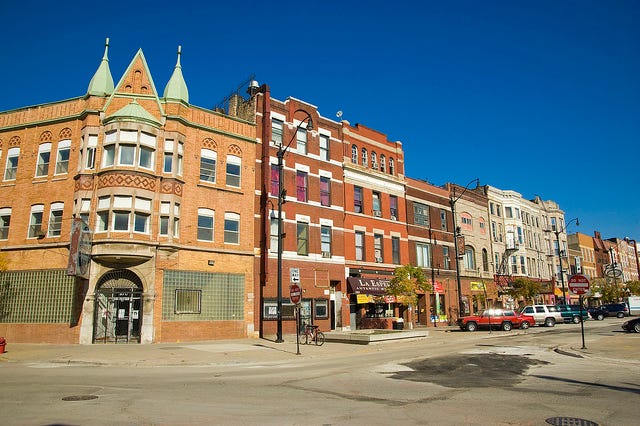
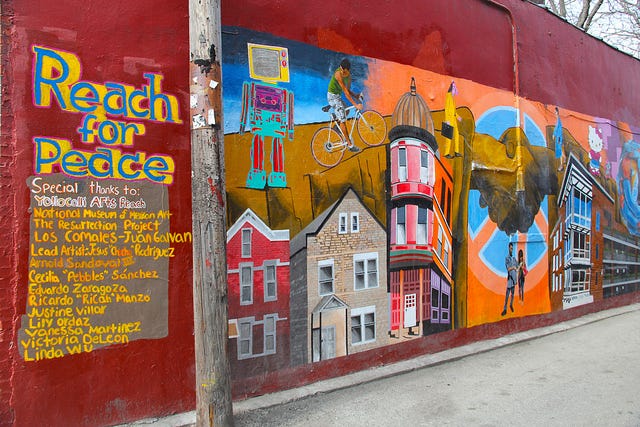
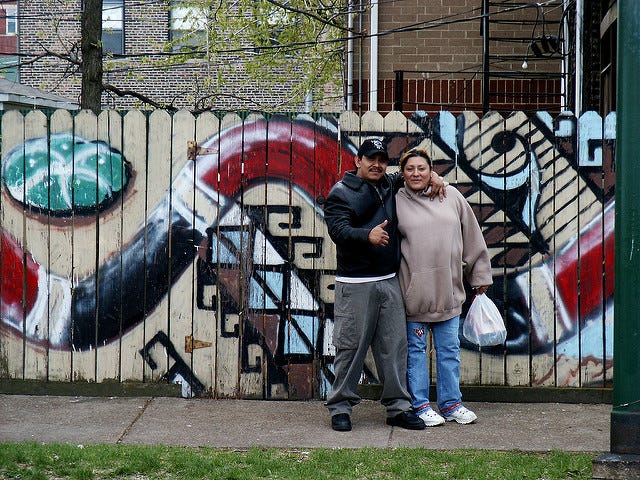
What I find particularly interesting is the manner in which the commodification of culture is used as a method to change the perception of community. There have been efforts for decades to remake Pilsen into a center of Mexican culture in Chicago and to minimize the crime and poverty.
Even before neighborhoods start gentrifying (which I define as the influx of higher-income, predominantly white residents into low-income communities of color), the way we talk about them can change its perception for the arrival of others. Pilsen went from an area deemed unsafe and stigmatized to a neighborhood brimming with culture. While Pilsen wasn’t considered gentrified in the early 2000s, it now “bears the marks of gentrification.”
Betancur and Smith point to how changing representations of both neighborhoods were key to facilitating gentrification even before gentrification actually began. In Pilsen, gentrification pressures started to be apparent on the east side of the neighborhood along Halsted St. starting in the late 1980s. In Bronzeville, a driving factor for gentrification was the demolition of thousands of public housing units starting in 1999. Both neighborhoods have experienced these outside pressures, but gentrification still hasn’t fully taken hold. “Despite this hoopla, Bronzeville and Pilsen are still quite poor,” they write. How much are neighborhoods shaped by the way we perceive them rather than the reality of a place?
Further south, Englewood is a good example for thinking about this question.
However, the authors argue, Englewood’s association with crime existed far before it became an African-American neighborhood.
Englewood was the well-known site of serial killer Dr. H. H. Holmes during the World’s Fair in the 1890s. Moreover, in the 1950s, a local crime prevention group formed a local police force to patrol the neighborhood. Few talk about crime in Englewood separated from its association to black criminality.
The chapter on Englewood is more than anything a history lesson and a discussion of the particularities of Englewood, such as the existence of vibrant organizations like Teamwork Englewood working to engage residents and an estimated 300 block clubs operating throughout, that make it more than just a crime-ridden neighborhood.
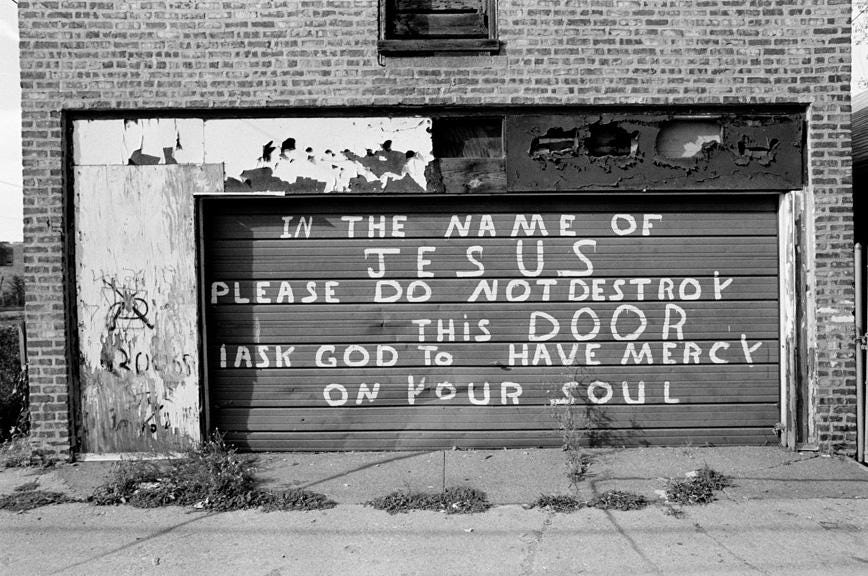
Taking an ahistorical view on neighborhoods, the book says, is what reproduces cycles of inequity. If we view neighborhoods less as finished products but part of a history of investment and disinvestment, we’ll be able to better identify ways to interrupt processes that create dynamics like gentrification and concentrated poverty. Neighborhood change doesn’t always happen naturally and that’s what history is able to tell us. If we see neighborhoods as unchanging, it’s a self-fulfilling prophecy. Neighborhoods aren’t static and they can’t be broadly defined with a term.
The trajectory of Englewood’s disinvestment started when the construction of the Dan Ryan Expressway sliced off the east edge. The subsequent erection of a 5-mile long wall of public housing high-rises (which included Robert Taylor Homes and Stateway Gardens) further segregated the black population.
Once a commercial center, Englewood saw the departure of big-name department stores, such as Sears and Wieboldt. Englewood went from 99 percent white in 1930 to 95 percent black by 2014, according to the most recent American Community Survey. In the midst of the challenges Englewood faces, Betancur and Smith find community organizations and residents working to create a better future for the neighborhood.
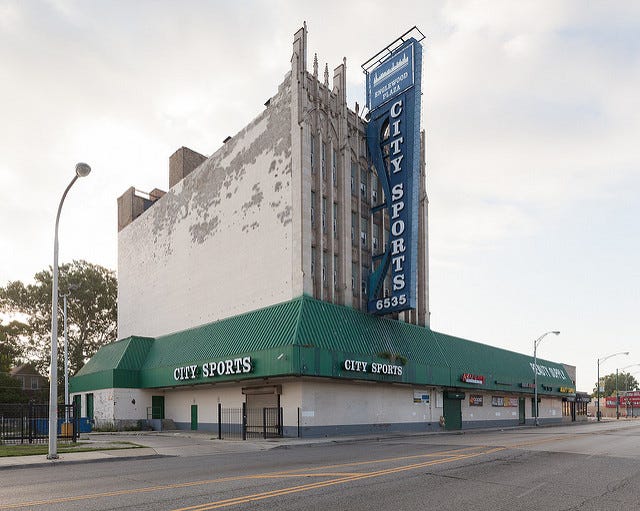

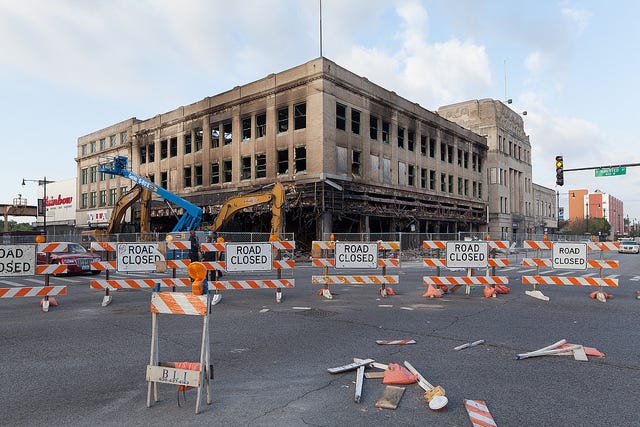
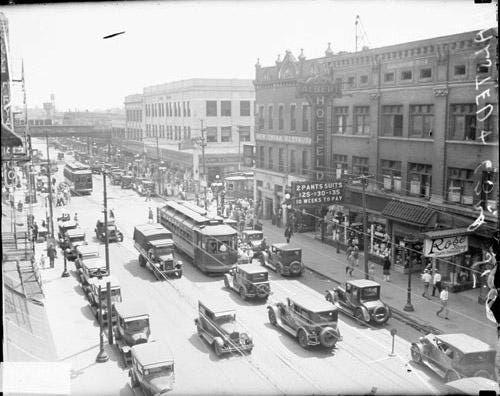
The authors argue that the final cycle of neighborhoods prior to a new cycle of investment is when it’s declared as an “unfit, dangerous, and socially disordered area” Afterwards, developers and capital can come in to “redeem” it.
We already see this influx of money making its way into Englewood, such as the Whole Foods on 63rd Street and a $50 million investment in the Southwest Corridor Collaborative to generate new businesses along 63rd St. in Englewood and adjacent neighborhoods.
Betancur and Smith warn that development in Englewood must follow another path without relying so heavily on market-based and real estate strategies to prevent displacement. Otherwise, they say, it will just lead to moving “the black underclass to new spaces of last resort.”
Betancur and Smith say some neighborhoods in Chicago are on the extremes of hyper-ghettoization and hyper-gentrification. There’s a growing need for affordable housing in Chicago, but “the market continues to develop units that are out of reach for most Americans.”
The construction boom on Milwaukee Ave. through Logan Square comes to mind, with rents going up to $3,900 for a 3-bedroom. With the challenges our city faces, Betancur and Smith leave us with key points to frame the way we view urban change and the steps we should take. Most notably, they drive home the point that we should see neighborhoods as flexible spaces that are often being shaped by processes for consumption and confinement (ex: gentrification and hyper-segregation) and that the way we perceive neighborhoods have to be informed by a historicized view of them.
Other posts by Lynda Lopez full archive
January 2017
- Chicago neighborhoods that have experienced disinvestment don’t need saviors to recover
📄 you're reading this one