Single stair would benefit Chicago families and make infill easier
Published on Mar. 30, 2026 by Steven Vance
Chicago is closer than ever to allowing single-stair apartment buildings, a building code reform that advocates say would unlock thousands of new homes on the city's smaller and oddly shaped lots. In May 2025, Alderperson Matt Martin (47th Ward) introduced an ordinance (O2025-0017571) that would amend the Chicago Building Code to allow a single exit stairway in residential apartment buildings — joining Seattle, New York City, Austin, and a growing list of cities and states that have already made this change.
A recent webinar hosted by Abundant Housing Illinois (AHIL) brought together four voices working at the intersection of housing policy, architecture, and advocacy to make the case for Chicago's reform. Watch the full conversation below.
Why the dual stair mandate matters — and why it should change
Current Chicago building code requires two stairways in apartment buildings above three stories. That requirement forces a long hallway to bisect every floor, which in turn forces developers to build at larger scales to make projects financially viable. (Alternatively, some developers will use three stairs to avoid the corridor, usually in buildings up to about six or eight dwelling units.)
The result is the block-long, corridor-heavy apartment building that dominates new construction — and crowds out the smaller, more neighborhood-scaled housing that Chicago's existing fabric was built around. It's often likened to a hotel.
Single-stair buildings dedicate up to 95% of floor space to housing, compared to 70–87% in double-loaded corridor buildings. They can be built on smaller lots, fit more naturally into residential neighborhoods, and produce larger, more flexible floor plans — better suited to families, seniors, and anyone who doesn't want a studio.
The safety case
Opponents of single-stair reform often cite fire safety as their primary concern, but evidence points the other way. A February 2025 report from the Pew Charitable Trusts found that single-stairway buildings as tall as six stories are at least as safe as equivalent housing with two stairs. Single-stair buildings have shorter evacuation distances — a maximum 20-foot corridor versus up to 250 feet in double-loaded buildings — and serve far fewer households per stairway. Combined with modern sprinkler systems, fire-rated assemblies, and pressurized stairwells, a single stairway provides adequate protection.
Seattle has permitted single-stair buildings up to six stories since 1977; New York City has allowed single stair buildings for even longer. Honolulu, Austin, and a growing number of cities and states have followed since 2025.
Single stair enables family-sized apartments
Mike Eliason, Director of Design and Policy at the Seattle Social Housing Developer, opened his presentation with a stark comparison: the double-loaded corridor building type that dominates U.S. multifamily housing "primarily induces smaller units," making it "really difficult to get large, family-sized units, except on the corners."
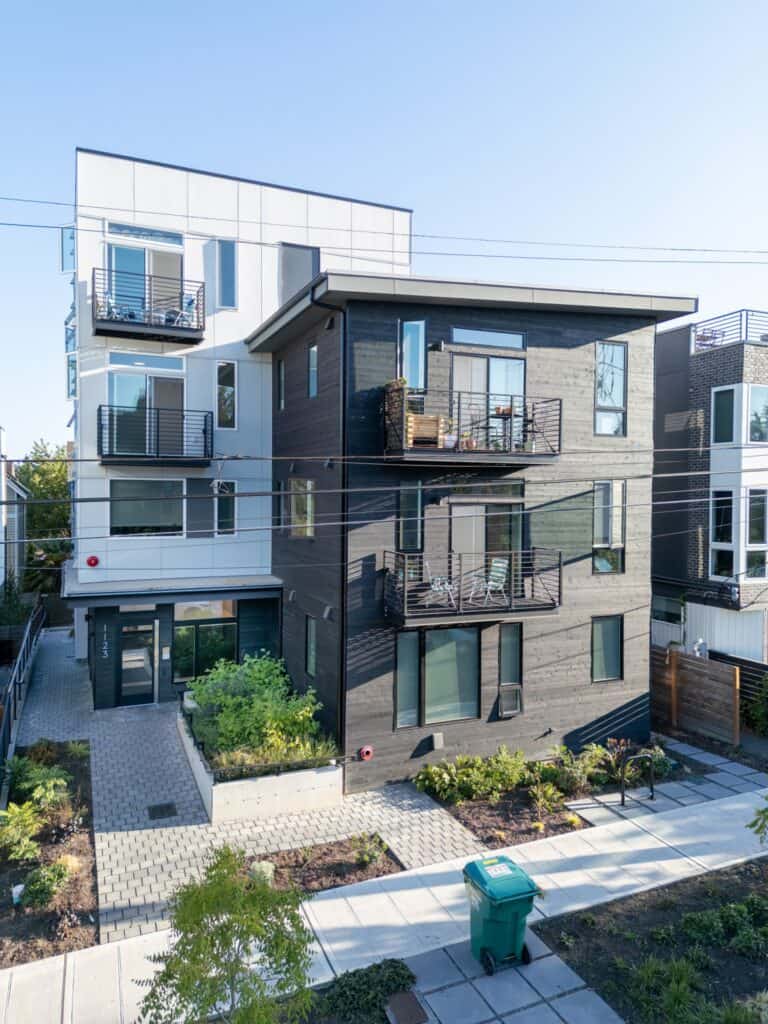 Sunlight suites: a simple change could unlock these beautiful homes — Sightline Institute
The problem, Eliason explained, is the deep floor plate required by the double-loaded layout. Units end up with windows on only one side — what he described as living in a bowling alley. A 1,000-square-foot two-bedroom apartment in the U.S. occupies the same floor area that, in a European single-stair building, would yield a three-bedroom unit with two bathrooms, a kitchen and living area oriented parallel to the facade, and daylight in every room.
"The single-stair building, the point access block, allows us to get better units. It also kind of induces larger unit sizes," Eliason said. "I can't even remember the last time I saw an apartment in Seattle that had four bedrooms. They're almost non-existent, but they're really, really common in European housing."
Single-stair buildings also eliminate windowless bedrooms — an increasingly common feature in West Coast multifamily construction — because units wrap around a central core and receive daylight on two or three sides. If a building sits on a busy street, bedrooms can face the quiet side, protecting residents from noise while sleeping.
"The typical unit layout in a single-stair building for a family-sized unit — abundant daylight, lots of windows," Eliason said. "It's not like living in a single-family house, but it does offer a lot of those qualities — the things that people want when they're looking for something like that, while still living and being in an urban environment."
Chicago's ordinance
The ordinance introduced by Ald. Martin — co-sponsored by Ald. Bennett R. Lawson (44th Ward), Ald. Anthony J. Quezada (35th Ward), and Ald. Ruth Cruz (30th Ward) — would amend Section 14B-10-1006.3.3 of the Chicago Building Code. It has been referred to the Committee on Zoning, Landmarks and Building Standards. Track its progress in the City Clerk's office. At the time of introduction it was also co-sponsored by Ald. Bill Conway (34th Ward).
The panelists
- Steffany Bahamon, Co-lead at Abundant Housing Illinois, provided an overview of the reform effort in Chicago and facilitated the event.
- Felicity Maxwell, Executive Director of Texans for Housing and AURA, shared lessons from Austin's successful campaign to legalize single-stair buildings, including how advocates navigated opposition from the fire department.
- Alex Montero, Lead at Strong Towns Chicago, discussed the local organizing effort and what single-stair reform would mean for Chicago's housing supply and neighborhood character.
- Mike Eliason, Director of Design & Policy at the Seattle Social Housing Developer, brought perspective from Seattle, which has permitted single-stair buildings up to six stories since 1977 — the longest track record of any U.S. city.
- Ben Wolfenstein, Director of YIMBY Illinois, discussed the state-level effort to advance single-stair reform through the Illinois legislature via the BUILD plan.
Tags
Click a tag to find more posts.
- Building code (1)
- video (2)
Other posts by Steven Vance full archive
March 2026
- Single stair would benefit Chicago families and make infill easier
📄 you're reading this one