The ordinance was introduced on May 20, 2020
See which alders support ADU legislation (map)
Read more posts to learn why you should support coach houses and accessory dwelling units(ADUs).
Biking on the Bloomingdale Trail last spring I spotted a “modern” coach house on Talman Avenue: It was new construction on the same lot as a new construction townhouse.
That didn’t make sense because coach houses are illegal in Chicago. The city’s current zoning code was adopted in 2004 at which point existing coach houses were considered legal, nonconforming uses. It bans new coach houses, but the ban started with the adoption of the 1957 zoning code.
Update: This post has changed since its original in April 2018, as I’ve learned a lot about accessory dwelling units (ADUs) since then.
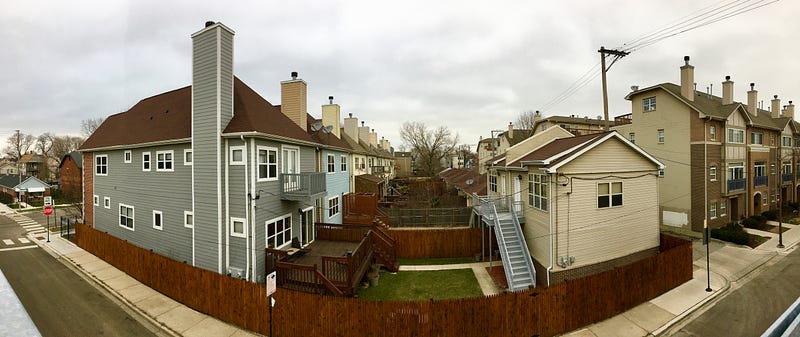
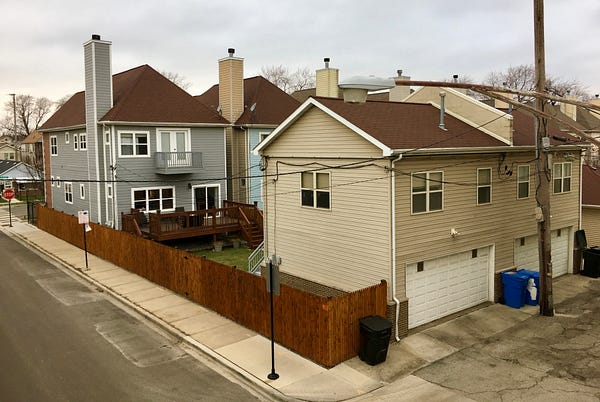
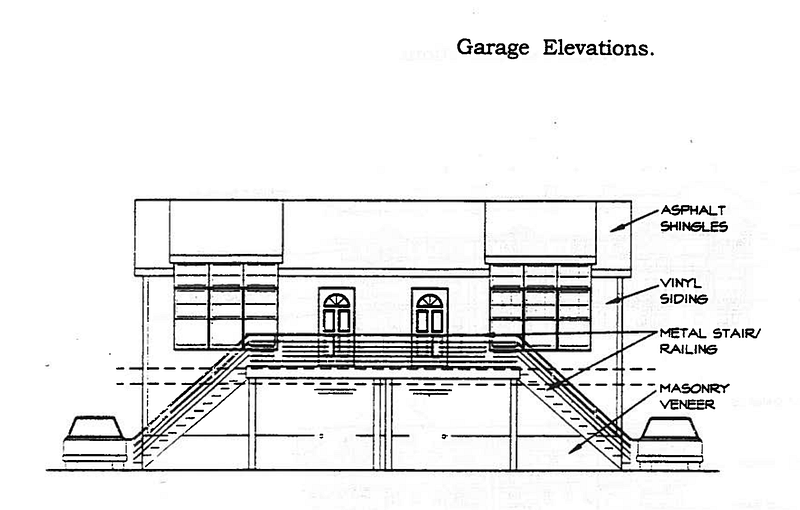
I noticed they were new construction, but I wasn’t sure how new they were really were. The building permit was issued in 2001 which said “ERECT A ‘NON-PAYING GUEST HOUSE’ ABOVE A 2-CAR PRIVATE MASONRY GARAGES AS PER PLANS”. (It’s not on Chicago Cityscape because we only have building permits from 2006 to now.)
A coach house is a typical kind of accessory dwelling unit (ADU) in Chicago that were built at the rear of lots. In the majority of cases, a principal use like a single-family house or 2-4 flat was built in the front of the lot. In rare cases, a coach house is the only building on the lot as a house up front was never built.

That zoning code recognized that an accessory structure could be built as a “non-paying guest house” that wasn’t allowed to have a kitchen. The code said that the house would be for guests of the occupants of the principal structure and “not for permanent occupancy by others as housekeeping units”.
This language wasn't carried into the 2004 zoning code. In addition to banning new coach houses and non-paying guest houses, existing ones cannot be expanded and there’s a rule that can cause their disuse. Maintenance and repairs to keep a coach house in “sound condition” are the only allowed kind of construction.
Matt Nardella, principal architect at Moss Design, said that coach houses are not an approved rear yard encroachment (garages, tool sheds, and required parking are approved). Outside of residential-only districts (meaning B and C districts), a coach house could still be built, he said, as long as the density of your zoning lot is high enough to allow for it, and that it’s not taller than 15'.
The current zoning code has this to say about coach houses (I’m paraphrasing) given their nonconforming status: If the coach house is unoccupied by a renter or family member for longer than a year, it can never be occupied or rented again.
If it’s demolished, it can’t be rebuilt If it’s accidentally destroyed, however, it can be rebuilt as it was — do it quickly, though, as it must be done within 18 months.
Bring them back
What’s great about coach houses and ADUs (including basement units), and why we should legalize existing ones and allow for the construction of new ones, is:
- They restore** population density in a neighborhood without affecting “neighborhood character” because coach houses and basement units can’t be seen from the street (this is one sense of “neighborhood character”, which is the way new buildings are often larger and look different)
- They create an additional income stream for the property owner
- They provide more affordable housing; existing coach houses are cheaper to rent because they’re older; this would stem the continuing loss of existing affordable housing in the region; if Chicago allowed prefabricated housing, new construction costs could be a lot cheaper
In California, ADUs are legal statewide and last year several bills were passed that made it cheaper and easier to obtain a permit (for example, a sewer utility can no longer charge a fee for hooking up an ADU). They’re legal in dozens of other cities in the country. Evanston City Council is considering allowing coach houses to increase affordable housing options although it’s still in committee.
**Many neighborhoods in Chicago have thousands of fewer residents now than at their peak.
Thank you Tim Barton, a zoning specialist who contributed to the 2004 zoning code rewrite, for helping me understand zoning rules in Chicago and lending me the 2002 zoning code book.