Chicago developers are constructing bigger wood residential buildings due to changes in the code
Published on Mar. 2, 2021 by Steven Vance

Nearly two years ago I co-wrote a blog post exclaiming one of the significant features of Chicago’s new building code: bigger wood frame buildings. This doesn’t mean that developers in Chicago can start erecting the kind of 50 to 150-unit “stick built” apartment complexes popular in California, Nevada, and Utah (see this new construction in Salt Lake City).
But it does mean that a space-limited 3-flat is no longer the maximum size, as it was in the pre-2019 Chicago Building Code. Since its adoption, a handful of building permits have been issued for bigger wood frame multi-unit buildings.
This is important because wood is cheaper and faster to build with.
Except, at the moment, lumber prices are extremely high due (doubled on some days, according to softwood market futures) to production issues largely caused by the COVID-19 pandemic. The Associated General Contractors of America “asked Biden to urge domestic lumber producers to ramp up production to address growing shortages, as well as to make the crafting of a new softwood lumber agreement with Canada a top priority of his administration” (Construction Dive).
What the 2019 Chicago Building Code allows
In the old building code, the top floor of a 3-flat couldn’t be larger than 800 s.f., which meant that the building (depicted below) was the biggest wood frame construction multi-unit that could be built. (The standards are in the old code’s Type IV-A construction type.)
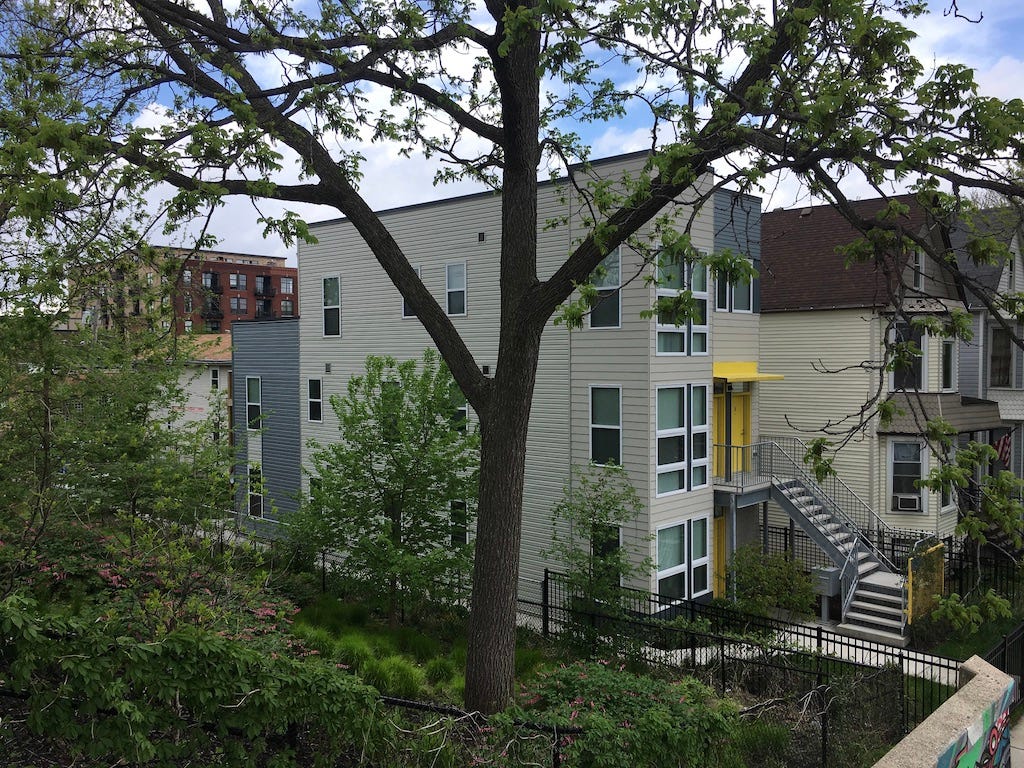
In the current CBC, a third story is allowed in a small residential building (occupancy class A) of Type IV-A construction if it is limited to 800 s.f. in area and the first and second stories are limited to 1,600 s.f. in area (13-48-030, note “h”).
The [previous] CBC allows up to 4,000 s.f. of building area in Type IV-A construction of a multi-story residential building (13-48-080); in single-story residential buildings, the limit is 5,000 s.f. The [newly adopted] CBC’s Type V-A limits area to 5,000 s.f. in a small residential building without sprinklers regardless of the number of stories. via MAP Strategies
In Chicago’s new building code, which adopted International Building Code 2018 edition, Type V-A dictates wood frame construction standards and removes that area limitation on the top floor allowing. The code still has area and height limitations on wood frame residential buildings but it’s now possible to build 10s of units using the new Chicago Building Code — with sprinklers, of course.
Let’s see some examples
PMPC Architects, founded by Prashanth Mahakali, obtained permits for two 4-flats last month (see the rendering at the top of the post). Both buildings will be in the Woodlawn community area. One of the lots has been vacant since between 1972 and 1983, and the other has been vacant since between 1988 and 1998 (Historic Aerials for the win).
Each of the three and a half story 4-flats has two duplex units, side by side. Each unit has three bedrooms and two bathrooms, and are identically sized with 1,940 s.f. of floor area. Each building — with about 8,000 s.f. of floor area — also has an NFPA 13R-compliant sprinkler system throughout the building.
Prashanth said, “Even with the lumber price increase, on a very conservative basis, this building will have at least over $250,000 in price savings by using wood and siding instead of masonry. This includes savings from building material, labor and delivery.”
The first “Type V-A” permits I noticed came out last summer, for three 6-flats, but the owner declined to be acknowledged in this post. All other Type V-A permits have been for single-detached houses and 2 or 3-flats.
Go bigger
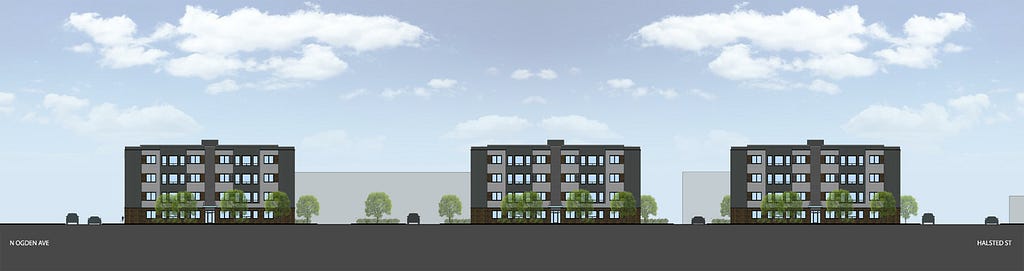
Wood frame residential buildings can be even bigger than four or six units. The next example of new construction wood frame multi-unit residences are three apartment buildings being built in the Near North Side (also on vacant land). Each Type V-A wood building has 16 apartments over four stories!
The development, called Schiller Place, was designed by Bailey Edward Architects, for Structured Development (which built the New City mall and apartments across the street) and Evergreen. GMA is constructing it and posted photos of the foundation formwork last week.
Are you developing a wood frame multi-unit residential building?
Chicago developers are constructing bigger wood residential buildings due to changes in the code was originally published in Chicago Cityscape on Medium, where people are continuing the conversation by highlighting and responding to this story.
Other posts by Steven Vance full archive