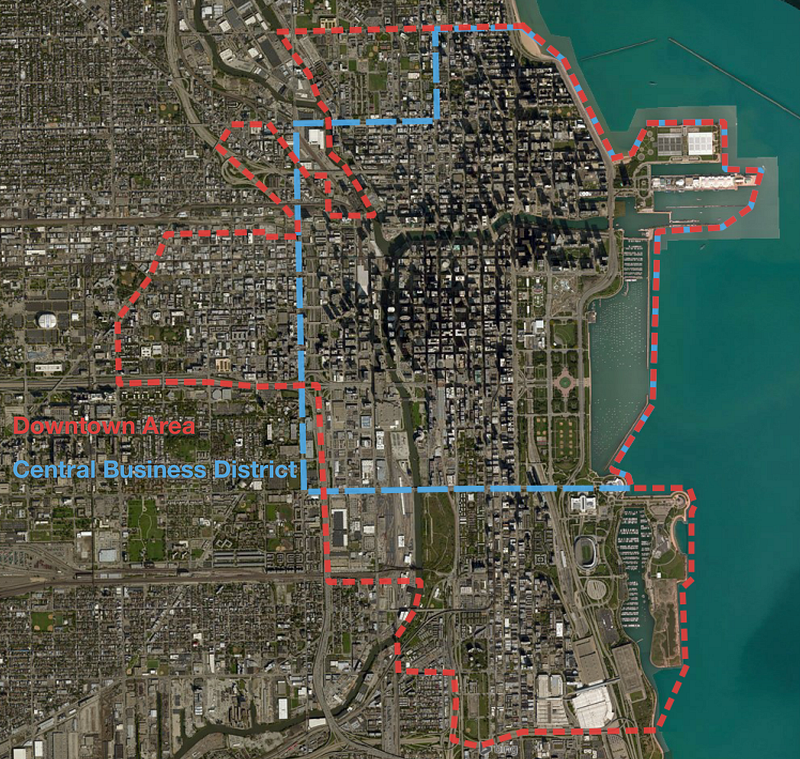
To anyone in the United States, downtown and “Central Business Districts” are used to refer to the place in a city where the densest amount of business occurs.
In Chicago these two monikers have legal definitions that affect civic administration of buildings and vehicles.
The downtown area is defined in the Municipal Code of Chicago’s zoning code, section 17–1–1500.
The Central Business District, or CBD, is defined in the vehicle and transportation code, section 9–4–010.
The city uses the “downtown area” to declare where property developers can receive for more density in their building as part of the Neighborhood Opportunity Bonus program (more on this in a separate post).
On the other hand, the CBD defines where parking regulations apply, affects how structures (like canopies and scaffolding) in the public way must be designed, adjusts permit fees for such structures, and gives the transportation commissioner authority to change parking and loading zones without an alderman’s permission.
The Central Business District, given its tight boundary around Chicago’s core business area, has a higher density of businesses:
- The CBD has 7,433 active business licenses issued under unique names
- The downtown area has 8,774 active business licenses issued under unique names
- The downtown area is about 72 percent larger but has only 18 percent more business licenses
- Our calculations include significant areas of Lake Michigan.
We have maps for these two boundaries — downtown area and Central Business District — and thousands of others. The two overlap quite a lot: the downtown area shares 56 percent of its land with the Central Business District.