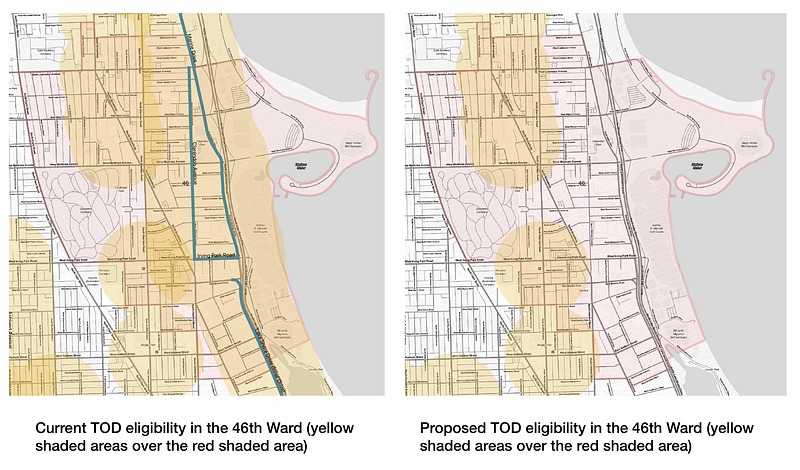
Update 1/28/19 17:42: 46th Ward Alder Cappleman has proposed removing the TOD bus route corridors from the 46th Ward. See below.
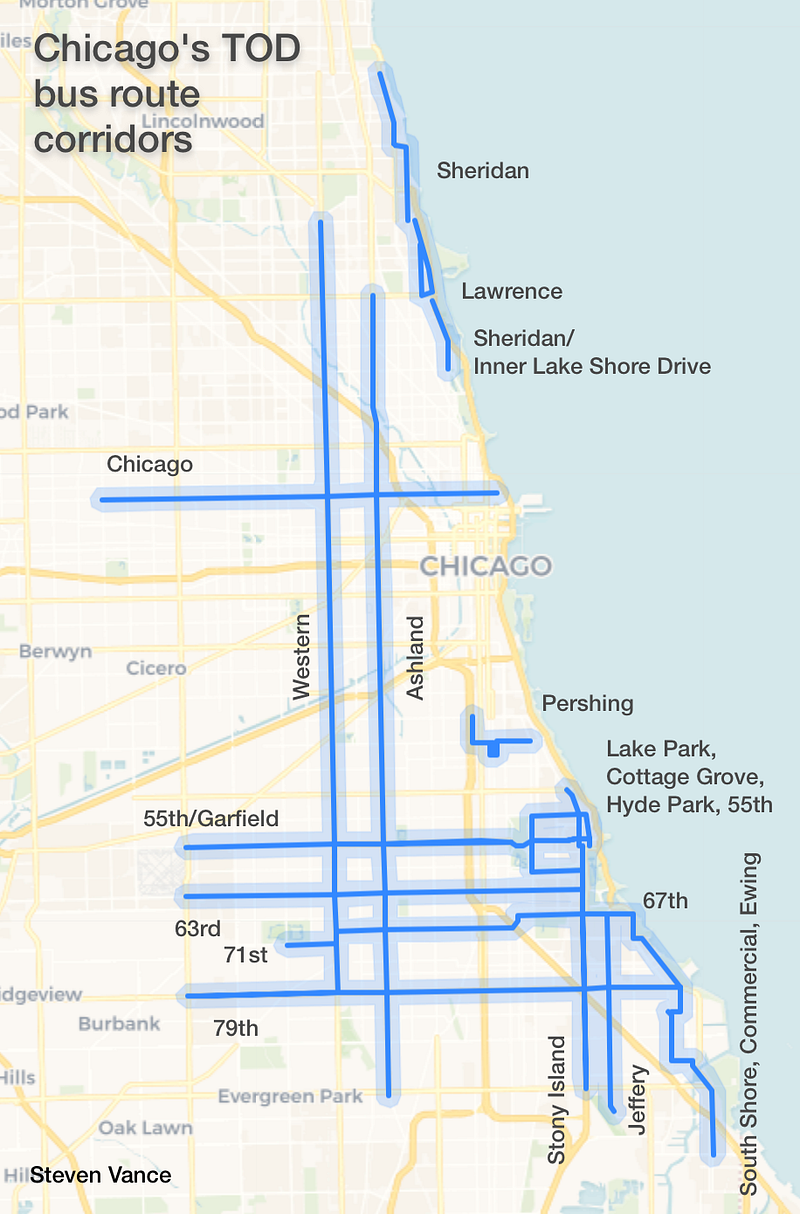
The same density bonus and parking reduction rules that apply to properties near CTA and Metra stations now apply to properties near selected bus routes. Chicago’s TOD ordinance (actually called Transit-Served Location) was amended last week to now include properties within 1/4 mile of bus route corridors like Ashland and Western Avenues, North Lake Shore Drive and Sheridan Road, and 39th, 55th, 63rd, 67–69th-71st, and 79th Streets, among others on the South Side.
Chicago Cityscape was updated the day after the ordinance was adopted to show a property’s proximity to these “TOD bus routes” when searching for addresses and Cook County PINs on our Address Snapshot functionality.
The TOD ordinance reduces the car parking minimum by 50 percent for new, expanded, and existing uses in B, C, D, and M zones, as of right. A further reduction can be taken by getting an approval through an additional process.
The TOD ordinance also offers density bonuses, as of right, for new, expanded, and existing residential and non-residential uses in -3 zoning districts (B2–3 and DR-3, for example).
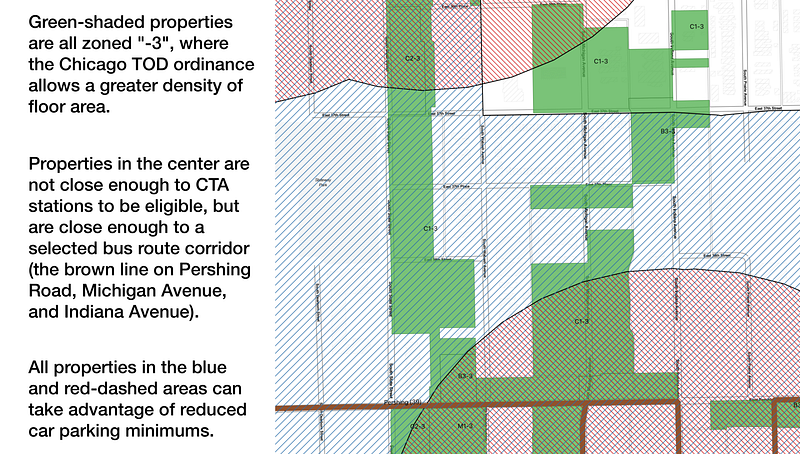
Adding selected bus route corridors to the TOD ordinance greatly expands the reach of the benefits: A grouping of properties with C1–3 and B3–3 zoning classifications are too far from the Indiana and 35th-Bronzeville-IIT Green Line stations, but they are within 1/4 mile of the #39 bus on Pershing Road.
This means that properties in this area don’t have to add new parking spaces if they add space or units to the buildings (for the most part), and that new buildings are required to have drastically less parking. And, because these zoning districts end in “dash 3”, the owners can build slightly more dwelling units, office space, or manufacturing space than those zoning districts normally allow.
The originally proposed ordinance, as submitted by the Mayor’s Office, would have extended the parking reduction rules to all RM districts. This would have been another game-changing part of the TOD ordinance, by allowing parking-light residential buildings in residential-only districts near high-frequency bus routes and CTA and Metra stations. This would have meant a return to traditional Chicago development, when courtyard-style apartment buildings were built with little to no parking.
Consider the Sheridan Road bus corridor through Rogers Park, which has dozens of these apartment buildings that could not be built like that today because today’s zoning code requires that they build one car parking space per unit. A 40-unit apartment building would have to have 40 car parking spaces — next to a high-frequency bus corridor — greatly increasing its cost and bulk.
The Chicago planning department said in its press release on January 23, that “since January 2016, more than 144 TODs containing approximately 24,419 residential units have been approved either as Planned Developments, Type 1 zoning amendments or by the Zoning Board of Appeals.”
A significant portion of those units would likely not have been built if not for the TOD ordinance. The TOD ordinance allows a “free” (as of right) increase in FAR from 3.0 to 3.5 (meaning more units are allowed) and reduces the car parking minimum (which reduces the bulk and cost of the building).