Exploration: How a “Standard 8-3” could be designed and built today
Published on Aug. 10, 2023 by Steven Vance
Updated on Aug. 14, 2023
When the Chicago City Council passed the Connected Communities ordinance last year they re-legalized six-flat and larger buildings on standard size lots — in certain zoning districts — by cutting the typical parking mandate of one parking space per dwelling unit.
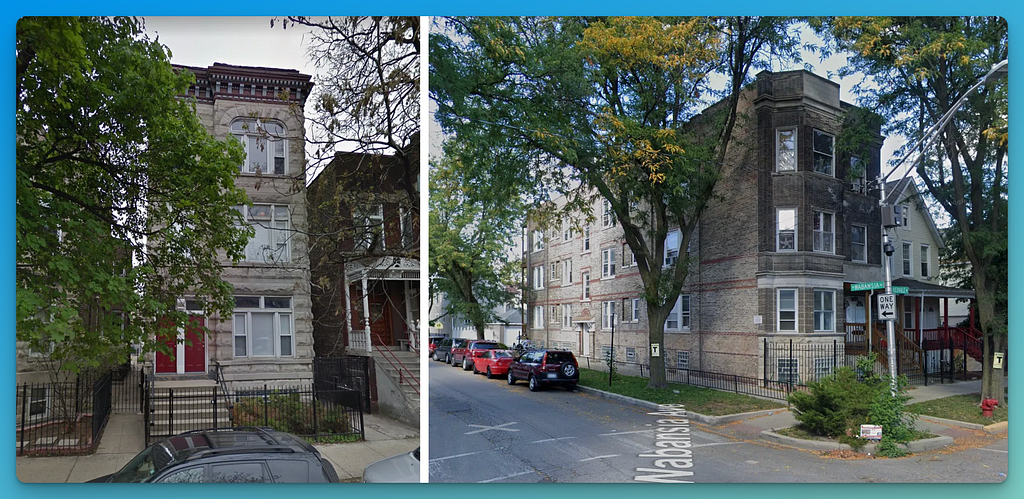
This enables two historical designs we’re calling the “Standard 6-3” and the “Standard 8-3”, which place six to eight units on a standard city lot and have two or three car parking spaces. Our post last year showed plenty of existing houses that are considered legal non-conforming designs but are once again permitted on properties in TOD areas and in RM-5, RM-5.5, RM-6, and RM-6.5 zoning districts
The historical designs, however, were built when zoning and building code standards were different — we wanted to show a version of what’s possible to be design today.

Aggregate Studio, a Chicago-based architecture firm, explored some massing and unit layout options for Chicago Cityscape, to visualize what’s possible given the constraints of the current zoning and building codes. Josh Mings, founder of Aggregate Studio, said, “It’s exciting to see the 8-flat typology return to legality through the Connected Communities Ordinance. This typology increases density in existing neighborhoods to address the housing crisis.”
The graphics below show a four-story building with eight 1-bedroom units, two stairs, and two off-street car parking spaces. Mings said, “Additionally, it’s highly flexible, allowing for a variety of unit types around the side stair core, such as accessible units on the ground floor, penthouse units, roof deck options, balconies, and a variety of exterior designs.”
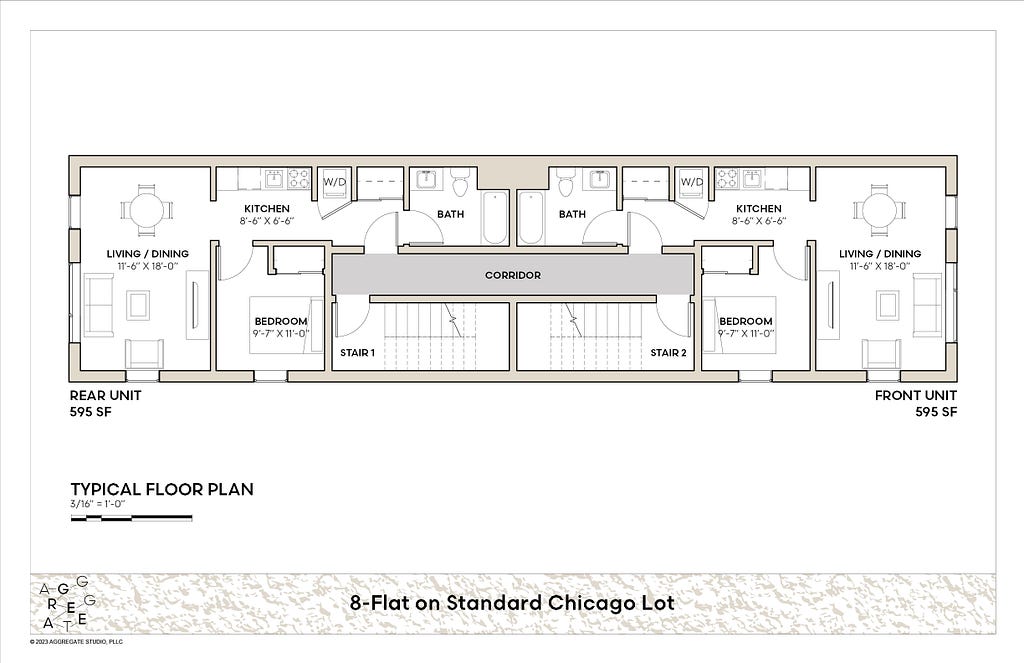

The massing diagram shows the required side, rear, and front setbacks, and the rear yard open space, in an RM-5 zoning district. The unit layout shows two 1-bedroom units of approximately 595 s.f. each.
Our new Knowledge Base article has additional details on the relevant building code and zoning code parameters that regulate this typology. Additionally, in the configuration shown sprinklers would be required for both Type 5A and Type 3A construction. In a three-stair configuration, sprinklers may be optional in Type 3A construction.
“Potential code revisions,” Mings said, “such as allowing for a single staircase, will increase flexibility. We look forward to exploring these opportunities and more with potential clients.” Contact Aggregate Studio.
Currently, New York City, Seattle, and the consolidated City and County of Honolulu, allow single stairs in buildings up to six stories while Chicago allows a single stair in buildings up to two stories — see table 1006.3.3(1).
Exploration: How a “Standard 8-3” could be designed and built today was originally published in Chicago Cityscape’s Blog on Medium, where people are continuing the conversation by highlighting and responding to this story.

Tags
Click a tag to find more posts.
Other posts by Steven Vance full archive