Filling a zoned “Pedestrian Street” gap will bring TOD benefits to more blocks
Published on Aug. 29, 2020 by Steven Vance
Updated on Oct. 16, 2020
Update: The proposed Pedestrian Street was adopted on October 7, 2020, and our map has been updated.
32nd Ward Alder Waguespack has proposed classifying the segment of Lincoln Avenue between Diversey and Belmont as a “Pedestrian Street”. This change would close a gap: Lincoln Avenue between Montrose and Fullerton, save for the proposed section and two tiny sections near Montrose, has already been classified as a P-Street.
See a map of existing Pedestrian Streets.
This zoning designation has several design and land use standards to maintain the pedestrian-orientation of a block by requiring transparent storefronts and limiting and banning car-oriented uses. It also reduces the minimum car parking that property owners need to provide to 0 spaces, and allows some a little bit more multi-unit housing.
Properties on P-Streets may also gain access to the city’s Transit-Served Location benefits they may not otherwise get because they’re too far from an eligible transit service. A Transit-Served Location (TSL) includes properties that are within 1,320 feet of an eligible transit service and properties on P-Streets that are within 2,640 feet of an eligible transit service; properties in both groups must be in B, C, D, and M zoning districts.
Eligible transit services in Chicago comprise all CTA and Metra stations (measured to their nearest entrance), and listed CTA bus corridors (measured to the road centerline).
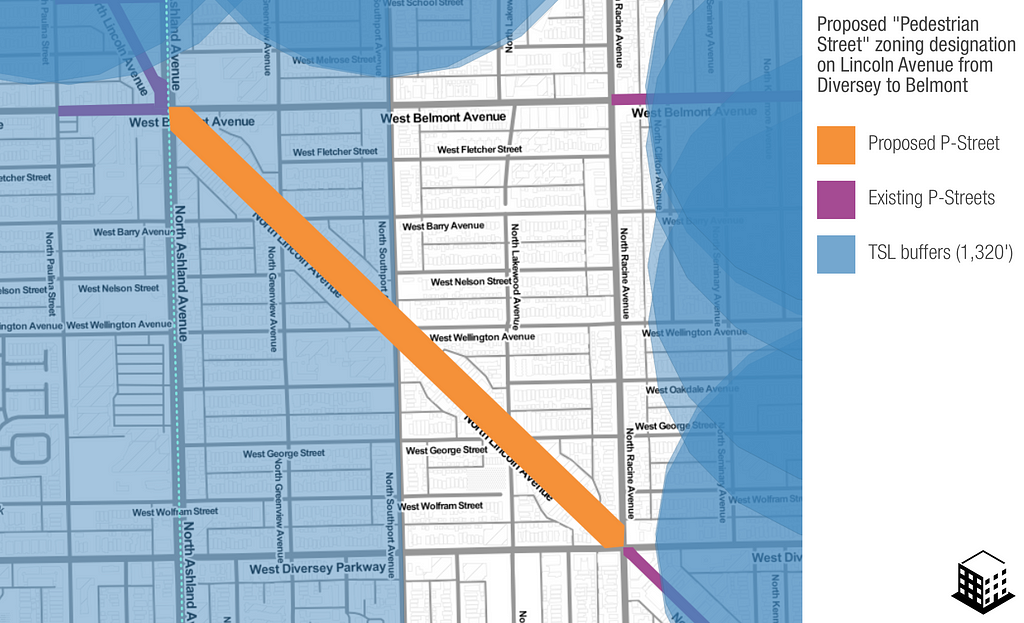
Currently, there are about 159 properties — that aren’t condos — along the proposed P-Street that are in one of the TSL-eligible zoning districts, and only 68 of them are considered a TSL because of their proximity to the Ashland Avenue bus corridor. When the P-Street is adopted, presumably in September, an additional 91 properties will be able to take advantage of the no-parking and more-homes standards of the Chicago zoning code.
I believe that it’s highly unlikely many of those buildings will suddenly be replaced with new buildings that are designed for the TSL standards, and it’s more likely that owners of the existing buildings will find ways to add more apartments because the limiting factor of having to provide those apartments with parking spaces will have been eliminated.
P-Streets exist only on the North Side, and in Pilsen, West Town, and Chinatown. Hyde Park and South Chicago each have one. It’s up to individual alders to ask the city’s planning department to initiate a study and ascertain their recommendation to designate certain blocks. The one in this article is the only one proposed this year.
Ordinance O2020–3947, introduced on 7/22/20, adopted 10/7/20.
Filling a zoned “Pedestrian Street” gap will bring TOD benefits to more blocks was originally published in Chicago Cityscape on Medium, where people are continuing the conversation by highlighting and responding to this story.
Other posts by Steven Vance full archive