This is a big year for solar energy in Illinois. Illinois has committed state funding and changed regulations to increase the amount of electricity that Illinois users get from solar panels. This post is about two things:
- Building more solar power sources in low-income and environmental justice communities because of a new state law called FEJA
- Showing how Chicago Cityscape can help
1. Building more solar power sources
The Illinois Future Energy Jobs Act (FEJA, “fee-juh”) was adopted in 2016 and created the Illinois Solar for All (ISFA) program. Elevate Energy, founded and based in Chicago, operates the program. ISFA will help homeowners, community organizations, and others get solar energy systems on buildings and on vacant land so that people in low-income households can reap the benefits of solar power.
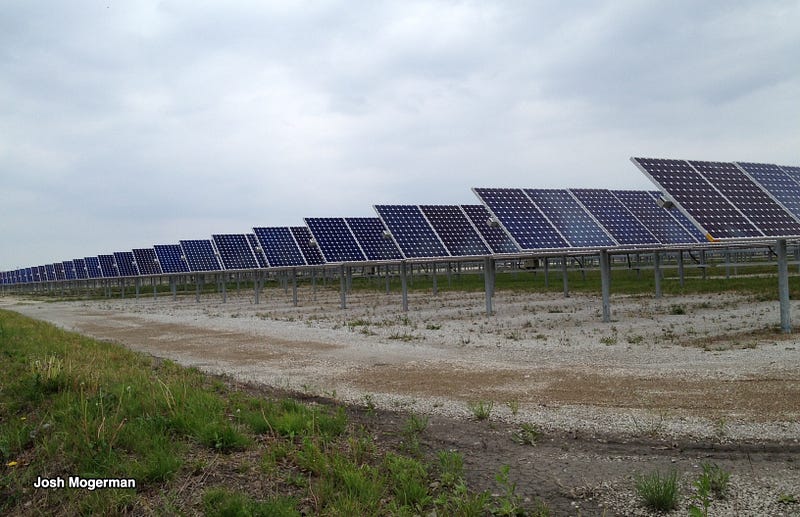
The Illinois Power Agency Act of 2007 requires that electricity utility companies in Illinois source 25 percent of their energy from solar and wind by 2025. FEJA amends that standard by requiring a significant portion to be sourced from low-income and environmental justice communities [1]. Additionally, 4,300 megawatts of new solar and wind power must be built.
Rather than rely solely on ComEd and Ameren to achieve the state’s goals, Illinois Solar for All is an incentive program to jumpstart building new solar panel systems. On the customer side, ISFA will find eligible people who either (1) can host new photovoltaic solar panels, or (2) want to buy power from local solar sources in a community (shared) solar setup [2].
On the property owner side, ISFA is approving vendors who will submit projects to be partially funded by an Illinois renewable energy fund. These properties can be residential rooftops, or buildings and land owned by non-profit organizations and public agencies in low-income and environmental justice communities (LI and EJ).
FEJA will give those approved vendors an upfront payment for their approved projects’ renewable energy credits; a REC represents 1 megawatt hour of electricity generated from a renewable energy source. The payment will equal 15 years of estimated RECs (with a premium) and be paid in the first year or over five years, depending on project factors.
For residential building owner-initiated rooftop solar projects, an approved vendor will be paid for the RECs of that system, and they will pass on some of the savings to the building owner. Residential properties must be occupied by low-income households but don’t have to be in LI or EJ communities.
Vendors must hire graduates from a solar job training program to complete a portion of the work (several of which are located in Chicago) — this brings a social benefit, as a portion of these graduates must come from LI and EJ communities. To control costs, capital and operating costs for the system aren’t allowed to exceed 50 percent of the value of the electricity generated.
Illinois Solar for All should spur more solar panel array construction, low-income households can potentially save on their energy bills, and Illinois can get more of its electricity from renewal resources.
Aaron Joseph, who has developed real estate and now develops solar panel arrays as Star Field Road, LLC, told me, “Illinois Solar for All is cool, and pretty unprecedented. Solar procurement is typically a commodity product. The unusual dynamic of the job training requirement changes things for solar companies.”
What’s happening now? The staff at Illinois Solar for All (Elevate Energy) are reviewing 29 community solar projects this week. The projects that end up getting approved will have 15 years of estimated RECs purchased and retired by the Illinois Power Agency in the first year, or first five years, depending on the project.
Want to participate?
Residents: Check to see if you or your tenants’ incomes qualify for the Illinois Solar for All program.
Non-profits and public agencies: Check to see if any of your properties are in low-income or environmental justice communities.
Contractors: Become an approved vendor.
Not eligible for Illinois Solar for All? Check out Solarize Chicagoland, a program operated independently of the State of Illinois to also increase residential solar by pooling customers to share in the cost of building new solar panel systems. Homeowners can start by requesting a site assessment.
2. How Chicago Cityscape can help
We’ve got maps, of course! These maps say if an address you’re looking up is in a low-income or environmental justice community. If it is, then the FEJA law and the Illinois Solar for All program — and the administrator, Elevate Energy — wants to install more solar energy sources there.
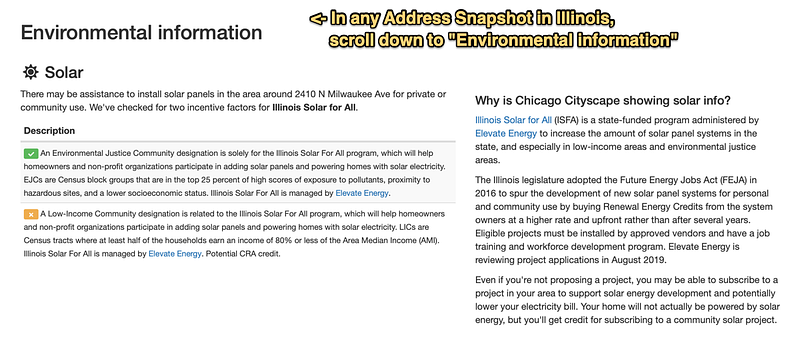
Look up an Address Snapshot anywhere in Illinois and scroll down to “Environmental information”. Voilà!
And that’s not all: We also have maps and data to make it easy to find vacant land — using Property Finder — on which to build larger, ground-based community solar panel arrays. It works in Cook County only, but we can develop the information for other Illinois counties upon request.
Notes
N.B. This post was originally going to review some actual solar projects, but just learning how Illinois Solar for All works and trying to explain that here took up all the time. Thank you to Aaron Joseph of Star Field Road for teaching me about Illinois solar regulations.
[1] An environmental justice community is one that bears disproportionately high or adverse effects of environmental pollution (Illinois Environmental Justice Act of 1997). For the purposes of identifying these communities which are used as a factor in sorting projects for funding dedicated to EJ communities, the Illinois Power Agency adapted a method from the State of California. The IPA explains its method on page 188 (PDF) in the Long-Term Renewable Resources Procurement Plan.
[2] Subscribers to community (shared) solar panel systems won’t actually get their home’s electricity from solar panels because electricity sources are mixed in the electrical grid, but subscribers’ monthly electricity fees — which could be lower than what they’re currently paying — directly support the generation of electricity via solar panels.