
A group of three alders introduced legislation last week that is intended to mitigate gentrification and displacement of lower-income families in an area surrounding part of the Bloomingdale Trail and parks of the 606.
Their ordinance is called “Pilot Act for the Preservation of Affordable Housing in the 606 Residential Area” and it would implement higher fees to demolish housing, build new market-rate housing, and to rezone a property intendend for market-rate housing.
We first reported on this potential ordinance in March. Part of the impetus for the ordinance is the fact that housing prices near the 606 have gone up more than housing pricess away from the 606, according to the Institute of Housing Studies at DePaul University.
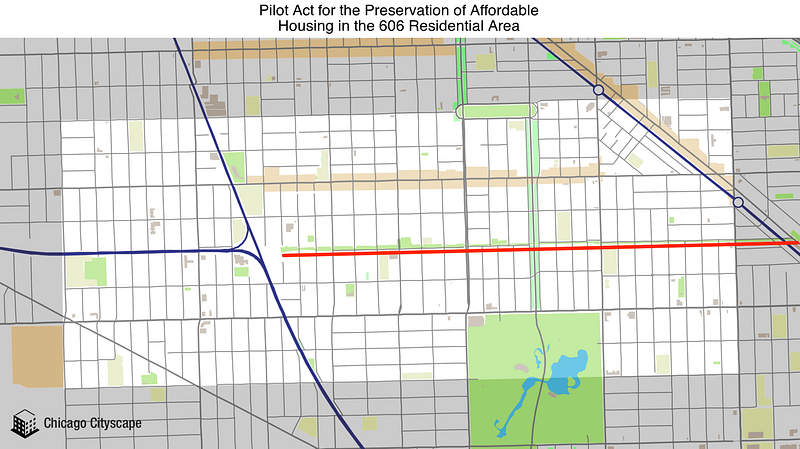
Where is the 606 Residential Area?
The 2.6 square miles area stretches from Kostner to Western Avenues, and from Hirsch to Palmer Streets, and contains 35 percent of the 1st Ward (Alder Moreno), 50 percent of the 26th Ward (Alder Maldonado), and 11 percent of the 35th Ward (Alder Ramirez-Rosa).
Where do the fees go?
Money from the fees would go into a trust fund whose board would comprise the three alders and members of the Logan Square Neighborhood Association (LSNA), the Latin United Community Housing Association (LUCHA), the Spanish Coalition for Housing, or the Center for Changing Lives. The members of those organizations would select two residents to be on the board.
The commissioners of the Department of Buildings and the Department of Planning and Development would also sit on the board, totaling 11 members.
The board would be in charge of disbursing funds by “review[ing] and approv[ing] or disapprov[ing] proposals submitted to it…which shall be used to create, maintain, or preserve affordable housing in the 606 Residential Area”. It appears that the proposed ordinance doesn’t contain any other spending requirements or restrictions.
How much are the fees?
A typical project in the West Town, Logan Square, and Humboldt Park community areas that involves demolishing an existing single-family house and replaces it with a single-family house would incur a $300,000 demolition fee and a minimum $100,000 development fee (for a replacement house smaller than 1,750 square feet).
A project that replaces a two-flat with a single-family house would have a minimum $450,000 demolition fee and a minimum $100,000 development fee (depending on the size of the replacement house). Larger replacement buildings cost more, and deconversions are subject to the fee for any lost units.
These fees apply when fewer than 50 percent of the units in the new construction or post-renovation building are not affordable units. The proposed ordinance defines affordable units as those which are affordable to households earning up to 30 percent of the area median income (AMI) when renting, and up to 60 percent of the AMI when owning.
There are also higher fees for zoning changes, which currently cost $1,025 regardless of location in the city or the extent of the proposed project. If the rezoning is for market rate housing the fee is a minimum of $300,000. For new affordable housing units the fee would be $500, half the current fee for all zoning changes.
Is there a discount on fees?
The board of trustees can waive these fees for:
- buildings that are structurally unsound according to a structural engineer, and the owner is going to build an equal or greater number of affordable units on the property;
- when the current owner’s income is below the Chicago area poverty level and proves that the renovation costs are higher than the appraised property value, and commits to building an equal or greater number of affordable units on the property;
- owners who are demolishing a property but commit to build an equal number of replacement, affordable units elsewhere within the 606 Residential Area.
How much money might the trust fund collect?
If the ordinance was adopted as of January 1st of this year, and if it had no affect on the number of demolitions and teardowns people applied for, the trust fund would have a minimum of $7.95 million.
I counted the number of demolition permits in the 606 Residential Area from January 1, 2017, to May 28, 2017, and divided them into single-family and multi-family buildings. (There isn’t enough data to determine how many units are in the multi-family buildings approved for demolition.)
There were demolition permits for 7 single-family and coach houses, for a total contribution of $2.1 million (at $300,000 each). There were demolition permits for 13 multi-family houses; assuming they were all two-flats, their fees is $450,000 each, for a total contribution of $5.85 million.