Update 3/22/19 20:06: A Village planner graciously emailed me to point out some misinterpretations and a mistake in the map. Those have been corrected.
Last week the Village of Oak Park’s board of trustees adopted a Transit-Oriented Development and inclusionary housing/zoning ordinance to require affordable housing in new apartment buildings in its newly established TOD areas. If you know the Affordable Requirements Ordinance (ARO) in Chicago, the rules in Oak Park will look familiar.
If a proposed development has 25 or more apartments and needs a zoning change from the village, then the development has to comply. Ten percent of the units in that development must be affordable to a household that earns 60 percent of the Area Median Income (AMI), which is the same rule as in Chicago. The original proposal set the bar at 80 percent, but it was reduced during the board meeting on March 11, 2019.
An amended version of the ordinance was passed and that hasn’t been published on the Village’s legislation website yet, so information here is based on a combination of the proposed ordinance and the board’s meeting minutes.
Developments that are proposing condos would not have to comply, although the ordinance does cover for-sale units should the condo exemption change.
Unlike Chicago’s ARO, people who apply for the affordable units in these future developments would get preference if they currently live in Oak Park, “have lived in Oak Park with a member of a household currently living in Oak Park”, or work in the village or are in a domestic partnership with someone who works in the village.
Instead of building the required affordable units, a developer can pay a $100,000 in lieu fee for each unbuilt unit. Any developer who pays an in lieu fee will not be eligible for building permit fee reductions or the density bonus.
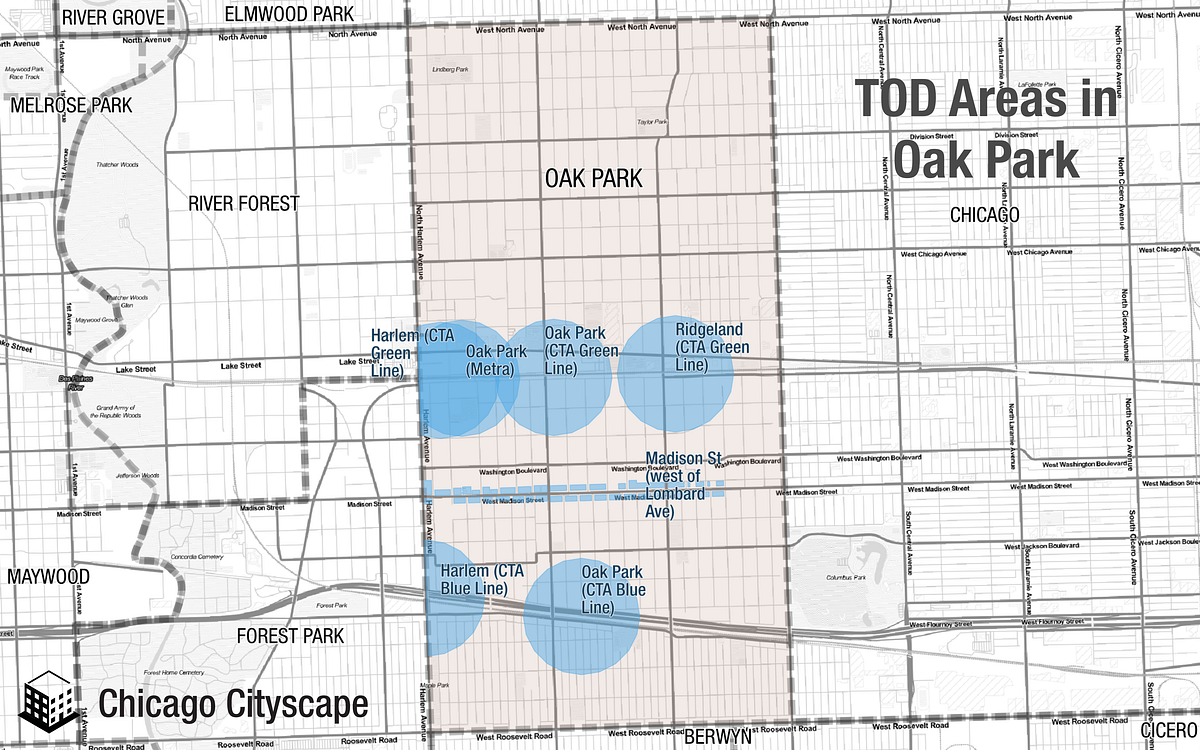
Oak Park’s TOD areas include the area within 1/4 mile (1,320 feet, same as Chicago) around the sole Metra station, and all of the CTA stations except the two on Austin Boulevard (one Green Line, one Blue Line). Additionally, the TOD area all of the “MS”-zoned properties on Madison Street west of Lombard Avenue.



The density bonus allows an additional market rate unit for each on-site affordable unit. Chicago offers a similar option, but calculates bonus units differently: If the developer provides 50 percent of the required affordable units on site, instead of the 25 percent on-site requirement, then the FAR increases by 0.25. If the developer provides 100 of the required affordable units on site, then the FAR increases by 0.50. With the increased FAR, the developer can construct slightly more market rate units, or larger units.
These TOD areas will soon be integrated so that when an Address Snapshot report for an Oak Park location is obtained from Chicago Cityscape, its eligibility for the TOD rules is shown.
I’m looking for feedback from Oak Park residents and developers active there for where there is developable land in the TOD areas. I may highlight these on the blog or on the website.