As I showed in the previous post, the RS-3 district is the predominant district in the 35th Ward, Logan Square, and Avondale and it only allows single-family houses to be built. It’s also the predominant zoning district in many other northwest side and north side wards.
RS-3 actually allows two-flat apartment or condo buildings to also be constructed but I left out this detail because I believe it’s impractical to use that part of the RS-3 rule to build two-flats. These are the conditions under which building a two-flat is allowed in RS-3 districts:
- There must be at least 2,500 square feet of lot area per dwelling unit
- The FAR is 0.90, meaning that the maximum area allowed in the building is 90 percent of the lot size.
The typical Chicago lot is 3,125 square feet (25 feet by 125 feet), which isn’t enough for the required 2,500 square feet of lot area per unit. To build a two-flat you need 5,000 square feet of lot area; then the units can be of any size combination adding up to 4,500 square feet (90 percent of 5,000).
There’s one exception that allows the two-flat to be built on a smaller lot, but still larger than the typical one: If 60 percent or more of the buildings on the same side of the block have two or more units, then the minimum lot area per dwelling unit is reduced to 1,500 square feet.
That’s just the right exception to build the two-flat on a typical lot size, since you only need 3,000 square feet on the lot. Then, you can build the units of any size combination adding up to 2,812 square feet (90 percent of 3,125). But why aren’t these blocks zoned RT-4, which allows 2-4 flats by right?
(Note that none of these calculations include required setbacks or required car parking, which will reduce the size of the building and its units.)
I’m going to summarize all of that…
You can build a two-flat on a lot in an RS-3 zoning district if either is true:
- You’re going to build on a typical lot size and 60 percent or more of the buildings on the same side of the block are two-flats or denser.
- You’re going to build on a double wide lot.
Strategy to allow more two-flats
Since single-family housing is the least affordable neighborhood pattern, and hurts transit ridership — especially in Chicago neighborhoods with ‘L’ service that used to be denser — there should be a strategic pattern of upzoning.
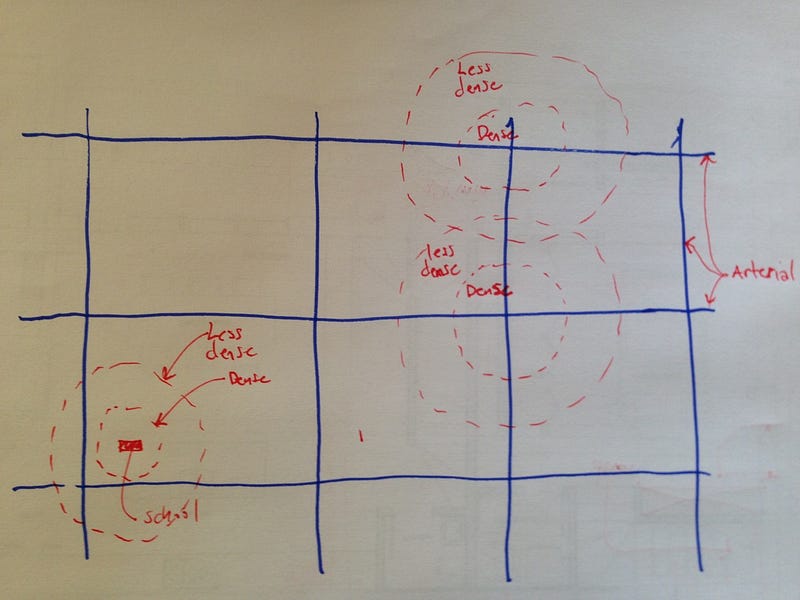
- Upzone areas around CTA and Metra stations and intersections with two high-frequency (12 minutes or lower) bus routes
- Upzone areas around schools (there will be pushback about overcrowding, but adding slight density is really not the harbinger people make it out to be, for one because it will take a while for density to increase) — on the other hand, many schools have declining enrollment, as does the school district as a whole
- Upzone blocks that have 60% or more of two-flats (really, this should have been done by the planning department in the first place — the zoning code already has exception in it that makes it like an RT-4 zone anyway); this kind of upzone should also allow a granny flat or coach house (accessory dwelling units, currently illegal in all districts), and would allow a basement unit that homeowners can rent out to earn some extra cash