The city could produce more housing if it upzoned areas around train stations to allow property owners to add a unit to their existing buildings, and build new apartment or condo buildings — instead, a lot of area around a lot of ‘L’ stations requires them to build only single-family houses.
Scroll down for the map.
Areas in the North Side around the Blue and Brown Lines don’t have the same medium and high-density zoning districts as the areas around the Red Line. This situation leads to lower housing production of the “missing middle” — housing that has more units than a single-family house, but wouldn’t be classified as a high-rise. A two-flat, a three-flat, a six-flat, courtyard building, compactly arranged townhomes, and other types.
This analysis measures how much single-family zoning is within 1,320 feet (two blocks) of a Chicago Transit Authority or Metra station, to show how space around them allows only the lowest density housing.
This is to make the case that zoning districts should be used to maximize the number of people that can live near a train station, not restrict it.
Across the city, 20 percent of the land area within two blocks of CTA and Metra stations allows only the construction of single-family houses. That’s 300 million square feet out of the 1.5 billion square feet around the stations.
Upzone that 101 million square feet from an RS (single-family only) district to RT-4 (which is one step up) and already you’ve essentially doubled the number of houses that can be built, through the use of two-flats. Depending on the lot size, you could even build 3 or 4 units. Step up to RM districts and you’re raising the ceiling of allowable number of new housing units by more than two times.
So how much land is restricted?
My point in the tweet thread was about the Blue and Brown Lines, though, so I’ll tell you how much of the land area around their stations south of Lawrence allows only single-family house construction.
- City zoning code bans apartment/condo buildings and allows only single-family houses on 50.6 percent of the land within two blocks of Brown Line stations between Kimball and Southport.
- Within two blocks of Blue Line stations (between Grand, the first station outside the Loop, and Jefferson Park, in line with the Kimball Brown Line station), apartment/condo buildings are banned on 39.3 percent of the land area which allows only single-family house construction.
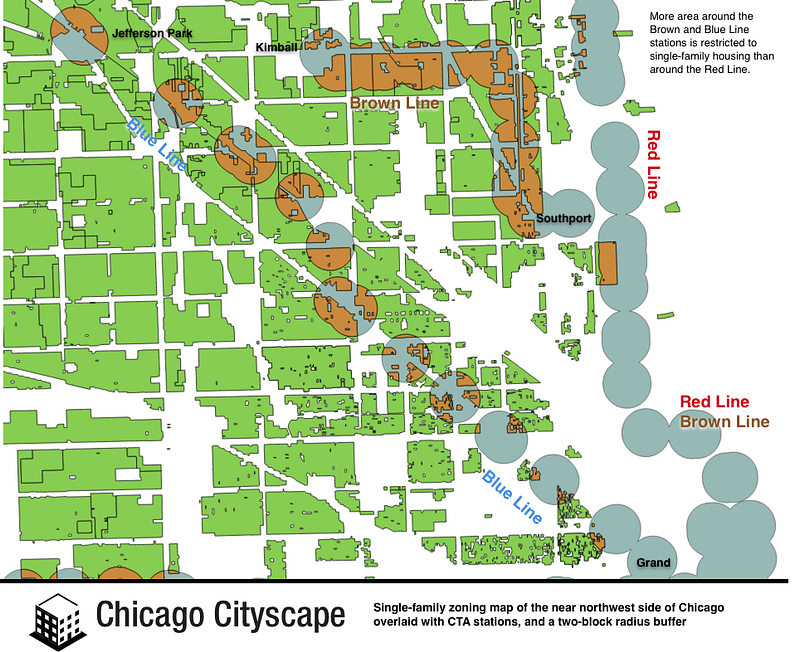
The map shows that Brown and Blue Line stations are more likely than Red Line stations to have a greater portion of the land within 2 blocks allow only single-family housing. The Red Line is surrounded by mostly RM-4.5 and greater, and Bx-3 and Cx-3 and greater. The white areas in the map are other zoning districts.
These numbers don’t account for streets in the zoning districts that you obviously cannot build upon, but subtracting street area wouldn’t reduce the portions that require single-family housing by much. This analysis will be refined to consider only the “buildable area” (parcels) near the stations.
There’s a lot of missed opportunity. Contact us to purchase a custom report.