Update: We added median gross rent for every neighborhood in Chicago.
The theme of the Latin@ Techies hackathon on Saturday in Pilsen is Fair Housing & Community Development, two crucial issues in Latin@ communities.
I’m showing up to share what information Chicago Cityscape publishes, and other data that can be used to understand and promote this theme.
It’s in our mission statement to “promote news on the South and West Sides” and “emphasize development of affordable housing and preservation”.
Specifically, data on Cityscape covers real-time building permits, which are issued when the city approves a construction or demolition project of commercial and residential development; it includes building violations and violation court data, which are citations and sometimes fines issued to landlords and property owners who don’t maintain quality housing or a structure.
Cityscape has information on neighborhood activity near train stations, in every ward and community area, and maps for dozens of TIF districts and official “investment zones”.
And for every one of those 2,800+ maps (which we call Places) we have downloadable information on population, income, and other demographic data from the Census.
Access it by clicking the “Show community data” button next to the map.
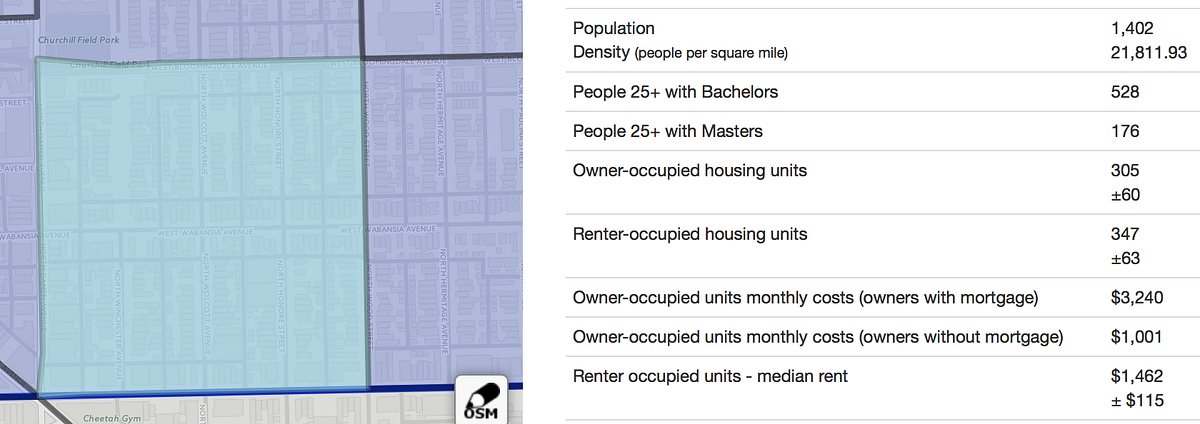
During a Twitter chat today using #chihousinghack to promote the hackathon I realized the demographic data on Cityscape was missing information about rents and housing cost burdens.
Housing cost burden means that too much of a person’s income, or their household’s income, is taken up by housing costs, including utilities. Someone or their household is burdened by housing costs if they pay more than 30 percent of their income in rent.
This “rule of thumb” is inexact and there are other ways to measure this at a community level. You can find where the cost burdens are the greatest in the Chicago Rehab Network’s Affordable Housing Fact Books.
Knowing rent costs, who rents, and where people rent, is really important in Chicago because 56.2% of households are renter-occupied.
I’ll be adding more information about rents to the demographic data on each Place page just as soon as I can figure out which Census tables have that information.
Stats about renting in Chicago
- The most common range of “cash” rents in Chicago is $1,000 to $1,249 per month, with 17.8% of renter-occupied households paying this much
- The second most common range is $1,500 to $1,999, 11.5%
- The third most common range is $800 to $899, 10.9%
- That most common range is paid mostly by households earning $50,000 to $74,999
- The third most common range is paid mostly by households earning $20,000 to $34,999 — a large portion of this group is likely housing cost burdened.
- In fact, 15.8% of renter-occupied households in Chicago earn $20,000 to $34,999 and pay more than 30 percent in rent. That’s about 93,495 households. (This number is based on 1-year estimates.)
- Just under 10% of renter-occupied households have utilities included in their rent (I don't know if this is important to understanding the rental ecosystem in Chicago, but I thought it was an interesting statistic)
- 27% (!!!) of renter-occupied households in Chicago pay more than 50 percent of their income in rent.