There are two design competitions this winter that have similar goals of spurring new ideas about redeveloping the missing middle — that is, small, multi-unit apartment buildings which are extremely common in Chicago, but aren’t being replenished — and creating a new affordable housing building typology.
What are your Chicago housing design ideas?
Published on Nov. 28, 2018 by Steven Vance
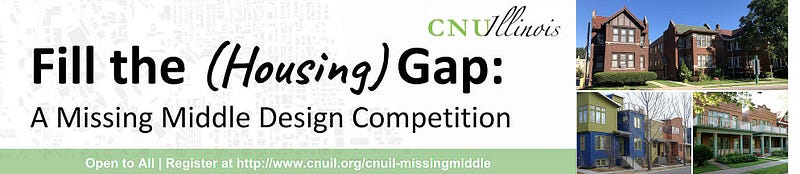
The Illinois chapter of Congress for New Urbanism (CNU) has organized Fill the Housing Gap: A Missing Middle Design competition. If you want to participate, you’ve got to register by the end of day tomorrow, Friday, 11/30 (sorry for the late notice).
Applicants must propose a “housing solution that would achieve medium-density yields while providing high-quality, cost-effective, marketable options between the scales of single-family homes and mid-rise apartments” for one of three undeveloped sites in Illinois:
- Chicago at 2567 W Montrose Ave (a building here was demolished in 2010) across the river from Horner Park
- Lake Bluff at 615–617 Sheridan Rd
- Peoria at 513 W Main St
Why is the competition necessary? CNU lays it out: “[Two-to-four flats] serve as the cornerstone of many Chicago blocks, but the city is losing these types at a rapid pace as they are converted to single family homes”. (We document this phenomenon on our Twitter, LinkedIn, and Facebook several times a week.)
Entrants will have to submit a pro forma and there’s a free webinar to learn how to create a pro forma on 12/5/2018.
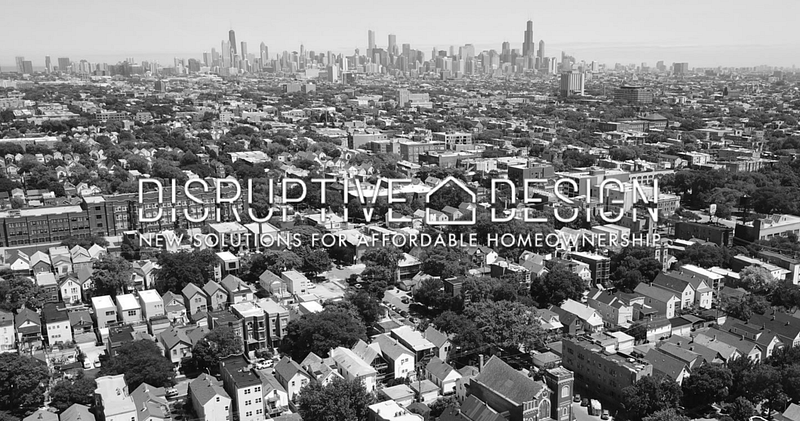
The other competition is Disruptive Design. The charge is to design a single-family house or two-flat that can be constructed for $200,000 or $300,000, respectively. The winning design will be built on two vacant lots in Bronzeville and West Humboldt Park. Registration starts December 1, 2018, and ends January 31, 2019. It requires an essay responding to specific questions in the design brief and one visual. The five entrants who are shortlisted after Phase 1 will be told the vacant lot addresses to design for in Phase 2.
With that information, the entrants must design a contextual house and submit floor plans and elevation drawings. After Phase 2, community meetings will be organized so residents can review the final five designs.
Anjulie Rao, editor of AIA Chicago magazine and one of the organizers, said the goal is to “create new possibilities for affordable housing” that “contribute to neighborhood connectivity”. She continued, “We want buildings that respect the existing neighborhood and create neighborliness.”
What does that mean?
You know when you see a new house pop up and it’s like a sore thumb; neighbors cringe and talk quietly amongst themselves about getting pushed out by wealth. Tension is created through design; in Disruptive Design, we’re implementing systems to create transparency in the process so people who already live in these neighborhoods are a part of the process. There’s nothing more dividing than seeing a vacant lot become a million dollar home and no one who lives on the block knows how it came to be.
Disruptive Design is co-organized by AIA Chicago and several foundations and NGOs, and funded by Related Midwest (which will also develop the winning design), Freddie Mac, and Polk Bros. Foundation, a Chicago-based organization.
← Older article
Emanuel closing five TIF districts early
Newer article →
Summary of fall 2018 TIF district changes
Other posts by Steven Vance full archive