The Chicago Metropolitan Agency for Planning is the official regional planning agency for northeastern Illinois, and is required by federal law to design and maintain a comprehensive plan which guides how some federal grants are spent in the CMAP region of Cook, DuPage, Kane, Kendall, Lake, McHenry, and Will counties.
The organization is creating a new long-range outlook plan called ON TO 2050, to be completed and adopted in October 2018. During the development of the plan, staff need to figure out what the priorities for land use and transportation in the region should be, which they gather by talking to hundreds of residents, organization leaders, and elected officials. Those talks are synthesized in early “strategy papers”.
Expanding Housing Choice (PDF) is one such paper, and I think these statements, quotes, and findings in the paper are pertinent to local and current issues in being able to provide affordable housing options in Chicago for those who need it.
Funding support for affordable housing is lacking
- “Strong federal support is still essential to meet the need for affordable units, as inclusionary housing programs have produced just 129,000–150,000 affordable units nationwide from the 1970s through 2010.” Inclusionary zoning is that which requires developers to build subsidized residential units, or pay an “in lieu” (buyout) fee.
- “preserving units in small rental buildings requires smaller-sized loans than in larger rental buildings. These small loans have become increasingly difficult to access, and lenders providing credit to these buildings have either left the market or shifted to larger loans.”
Multi-family buildings are sidelined
- “Between 2007 and 2011, FHA provided approximately $1.1 trillion in loan guarantees for single-family housing and made only one-tenth of that investment ($112 billion) for multifamily housing. Providing significantly more low-cost loans for single-family homes skews the market for that type of housing.”
- “Recent research on loan performance [indicates] that loans in walkable, mixed-use communities are less risky than those in residential-only communities, [but] the perceived risk associated with mixed-use development is a major barrier to meeting housing demand and providing housing choice. Mixed-use projects are inherently more complicated and costly than single-use projects, and that has contributed to the widespread belief that they pose a higher risk to investment. As a result, lenders tend to prefer standard real estate products that support single-use over mixed-use development.”
Regulations affect housing production and funding performance
- In areas the lack land for new development or where residents “may lack the willingness to add density” (a.k.a. local opposition), “local regulations and policies can strongly shape market outcomes, including limiting the overall supply of housing, such as by zoning areas at densities lower than what than what the market (or potential residents) would support. This also often increases the cost of remaining housing.”
- “overly burdensome regulations; inefficient or ineffective local decision-making about their use; and funding cuts” challenge the success of “local subsidy programs (Community Development Block Grants, Illinois Housing Trust Fund, and Low Income Housing Tax Credits)”
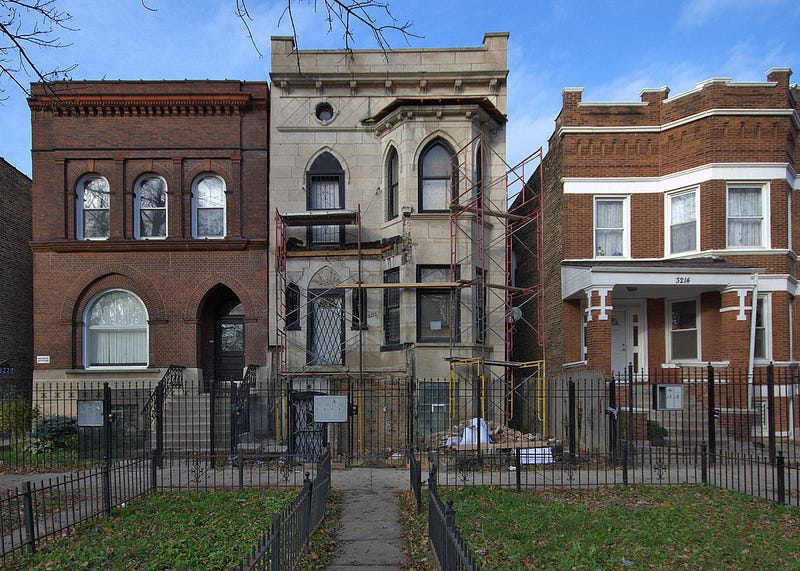
Low-cost rental units are harder to find
- “From 2000 to 2015, the region gained rental units in single-family homes, townhomes, and multifamily buildings with 50 or more units.31 Meanwhile, it lost rental units in smaller multifamily building types, partially attributable to the growth of rental units in other types of buildings and the increasing popularity of ‘de-converting’ 2–4 unit rental properties into single-family homes in communities with strong markets.”
- “As some rental buildings get older, rents in those buildings stagnate or decline, leaving them affordable to income groups that previously could not live in them, a process called filtering. While it improves housing affordability, filtering does not fully address the growing gap between the supply of and demand for lower-cost rental units.”
Feds won’t fund walkable and mixed-use neighborhoods
- “Americans increasingly prefer to live in walkable neighborhoods that mix commercial amenities with single-family, townhome, and multi-family homes (i.e. mixed-use neighborhoods). Yet, federal housing rules favor homeowners over renters and single-family homes over multifamily homes, and create policy barriers to market changes.”
- Projects with ground floor retail and apartments above “frequently struggle to qualify for federal financing and loan guarantees. The U.S. Department of Housing and Urban Development (HUD), Federal Housing Administration (FHA), and Fannie Mae and Freddie Mac programs all limit the amount of non-residential space allowed within developments as a condition for receiving federal financing or loan guarantees.”
- “For example, a mixed-use project seeking financing from Freddie Mac can have a maximum of only 20 percent non-residential use, meaning (generally) that the building must be at least five stories to accommodate ground-floor retail. In the CMAP region, this building height may be out of scale with existing communities or noncompliant with existing zoning regulations.”