Designers, lenders, and city staff gather to discuss current, future ADU policy
Published on Apr. 25, 2023 by Steven Vance
Last month 100 people got together to talk about accessory dwelling unit policy, design, construction, and financing, in Chicagoland. The timing was deliberate: it’s been over three years since Chicago first adopted a housing plan that said the city should legalize ADUs, and the two year anniversary of when new ADUs were allowed is coming up on May 1.
The organizing group, which comprised myself, the Preservation Compact, the Chicago Metropolitan Agency for Planning, and Sightline Planning & Zoning, wanted to assess the current “state of affairs”, so to speak, and address what shortcomings in knowledge and resources there are that could support greater ADU adoption in Chicago and the region.

My personal impetus was a desire to host an ADU fair — modeled after several that have occurred in California — where property owners could come and learn how to build ADUs. After discussing this with the group, there was consensus that such a fair wouldn’t fare well because there isn’t enough information to provide the would-be attendees.
One goal of the ADU event was to try to figure out where our knowledge was lacking and what resources need to be developed to provide homeowners and landlords to get the ADU-building machine working a bit faster.
At the time of publication, 10 municipalities (including Chicago) permit ADUs in some form or another. Chicago has issued 148 building permits for 181 ADUs. Basement units are the most common type and several owners of larger buildings are constructing two or more basement units.
This article summarizes the keynote, the three panels’ conversations, concluding with a list of unanswered questions. (Want even more detail about the conversations at the event? Read the summary by Isabel Kennon, and explore the panelists’ names and biographies.)
Let’s recap
CMAP’s Executive Director Erin Aleman spoke about the agency’s role in developing regional housing strategies, which is now allowed by the new federal transportation bill. She emphasized the importance of stable housing for economic recovery and applauded the communities that have changed zoning requirements to allow for different housing types, including ADUs.
The Preservation Compact, whose mission is to preserve the region’s stock of affordable housing, sees ADUs as a tool to increase naturally occurring affordable housing stock. Director Dunni Cosey-Gay praised the work of advocates like Dianne Limas and Stacie Young, who have helped catalyze conversations and implement policies around ADUs in the Chicago area.
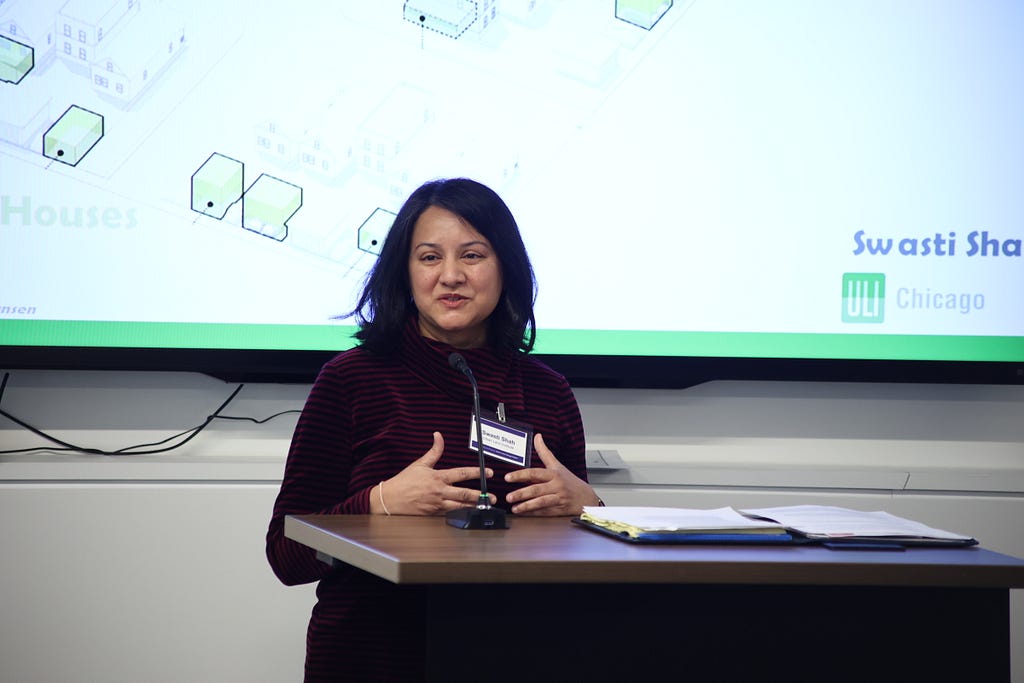
Keynote speaker Swasti Shah, Director of Community Engagement at the Urban Land Institute (ULI) Chicago chapter, spoke about the benefits and challenges of ADUs. Shah had the privilege of leading many in attendance at the ADU event on a task force in 2019–2020 to develop policy recommendations for Chicago and the region.
The challenges she stated included restrictive zoning and lengthy or difficult permitting, high cost of construction, scarce financing options, and an absence of guidance or expertise for homeowners. Shah emphasized that continued interventions (policy and program changes) and educational opportunities are necessary to see a higher take-up rate.


The three panels
Municipal Policy
The Municipal Policy panel focused on the planning, politics, and public policies of ADUs, with panelists representing the governments of Chicago, Oak Park, and Bensenville. They discussed the challenges of implementing ADU policies, such as addressing existing informal ADUs without displacing current tenants, standardizing owner-occupancy requirements, and addressing parking requirements for detached ADUs.
Unique in this panel is that Bensenville does not permit ADUs, but not for a lack of trying (read the full summary for more info).
Chicago’s housing department is in the process of hiring a staffer who will focus part-time on ADU policy and promotion, a sign people hope points to the program’s expansion, which is limited to five pilot areas. The 2:1 parking standard for single family homes in Chicago poses a challenge, as it requires detached ADUs to be coach houses above the garage. These units aren’t accessible to people with disabilities and don’t serve the aging population targeted for ADUs — an alternative regulation could be adopted to allow parking on the side of a ground floor unit.
Design & Construction
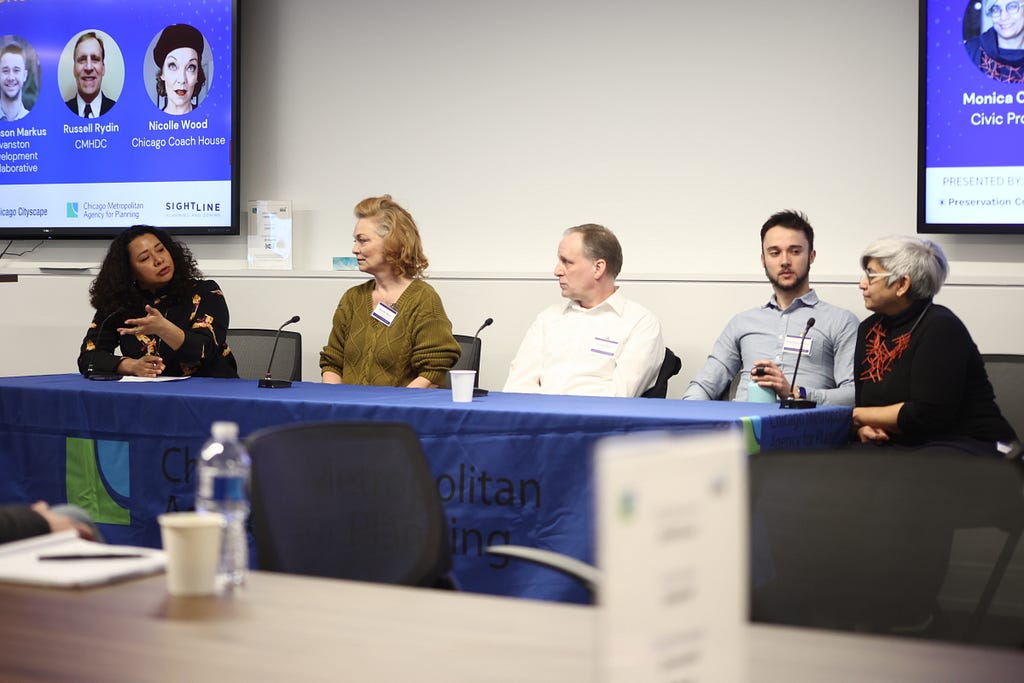
The Design and Construction panel comprised plenty of experts with direct ADU experience in Chicago and Evanston: an architect and developer, a cooperative development company leader, an affordable housing developer, and someone who built their own coach house.
The panelists emphasized the importance of specialized design and budget plans that take into account the homeowner’s reasons for wanting an ADU. They also discussed the challenges of high construction costs and the need for financing options to make ADUs accessible to more homeowners.
Another idea proposed: pre-approved plans coinciding with a “pre-development” checklist to reduce design costs and complexity for homeowners. Plus, the architects on the panel and in the room showed that they all get a significant number of inquiries from Chicagoans who don’t have the benefit of living in an ADU pilot area.
Financing & Resources
The Financing and Resources panel discussed the issue of equitable access to financing as well as financial supports for ADUs. The panelists represented different organizations working in the field of ADU financing, such as Guaranteed Rate, a major local residential lender, CIBC bank’s Housing Initiative, the Community Investment Corporation, and Neighborhood Housing Services of Chicago. Each panelist specializes in a different form of lending or grant-making; there was almost no overlap between the types of projects to which they specialize lending.
Descriptions of the types of projects that the four lenders can facilitate can be found on Chicago Cityscape’s ADU Funding & Financing webpage.
Panelists highlighted the challenges in financing ADUs due to high interest rates, and the lengthy bureaucracy time to complete projects. The panelists suggested relaxation of owner-occupancy restrictions for multifamily owners to construct ADUs and called for the creation of an ADU desk within the City government. Donna Clarke, COO for NHS Chicago, called for the end of the pilot areas and permitting ADUs citywide.
The panel also discussed the challenges in appraising ADUs due to the lack of institutional education and guidelines. Many appraisers appear to not know how to categorize ADUs, which makes it difficult to appraise them accurately. Appraisers have often valued a finished basement living area higher than a basement residence, which impacts the equity homeowners can use towards a loan.
The panelists hoped that more ADUs coming onto the market would provide additional comparisons for underwriting, thus easing hesitations from appraisals and underwriters. They also highlighted that appraisal bias contributes to the racial wealth gap because homes being undervalued are reducing the equity that homeowners can access.
A big list of unanswered questions
If you have some answers or want to help get to the bottom of the answers, feel free to email any of the organizers. But I would advise you to direct most of your efforts to where the power in policymaking lies: your city council and village board members.
- What is the property tax impact for owners of ADUs? (One aspect of this question that we know the answer to is that the first $70,000 of home improvements are exempted from the assessment for several years.)
- The high price tag of ADUs makes them inaccessible to many homeowners, are we making wealthy homeowners already wealthier?
- How can we incentivize landlords to legalize their informal ADUs and bring them to code?
- How can we do so without displacing the current tenants?
- In Chicago, what else is needed to push the pilot program to become a citywide ordinance?
- What interventions are needed to encourage uptake of the program in other municipalities?
- How do we support homeowners in managing the cost of constructing an ADU?
- Are subsidies an answer, or does there need to be educational work in the private sector to encourage banks to lend more in this category?
- How much does an ADU cost? (This question has some answers — Chicago Cityscape has gathered some statistics on its ADU Funding & Financing webpage— but the short answer is that there’s wide range of costs.)
- Similarly, can we estimate the average cost to share with homeowners?
- How does modular construction intersect with ADUs and could that be further explored to reduce costs? Recall that Chicago has two modular house manufacturers.
- How do we use ADUs to increase wealth in communities of color without increasing the wealth gap for people who are already homeowners?
- How do we improve education for appraisers? Relatedly, how do we improve equity in the appraisal process to ensure it builds wealth?
- How are we proactively designing basement units to prepare for extreme weather events and risk of flooding?
- Are there objectives or metrics for Chicago’s ADU pilot program?
- What does the next ADU ordinance look like?
- What would a path to legalize illegal basement units look like?
- How will we create affordable units with the ADU?
- How can we use federal money to fix up existing basement units?
- Do we need to strengthen the size and ability of the region’s construction workforce?
- Should Chicago require testing for contractors to help property owners hire qualified workers?
- Should the City’s grant increase funds per project or change the requirements to expand the eligible group of homeowners?
Other ways to stay in touch
- Urban Environmentalists of Illinois has a petition for individuals to show their support for expanding ADUs citywide in Chicago
- Chicago Cityscape has been collecting information about people’s successes and struggles in funding their ADU projects through the form at the bottom of our Funding & Financing webpage.
- Contact an ADU expert using our Service Provider Directory.
Designers, lenders, and city staff gather to discuss current, future ADU policy was originally published in Chicago Cityscape’s Blog on Medium, where people are continuing the conversation by highlighting and responding to this story.
Other posts by Steven Vance full archive