It’s that time of the year: Chicago Cityscape has integrated the most recent Cook County property tax data to include the 2018 tax bills and assessments. Annually we update our massive database of over 1.9 million parcels to include the most recent tax year, right after the second installment tax bill of the previous year is sent out. (It’s due August 1, by the way.)
This means those brokers, reporters, real estate developers, and even Chicago Ward offices, now have the latest comprehensive information about properties. Here’s how to access the data for an area.
Use the data for a single property
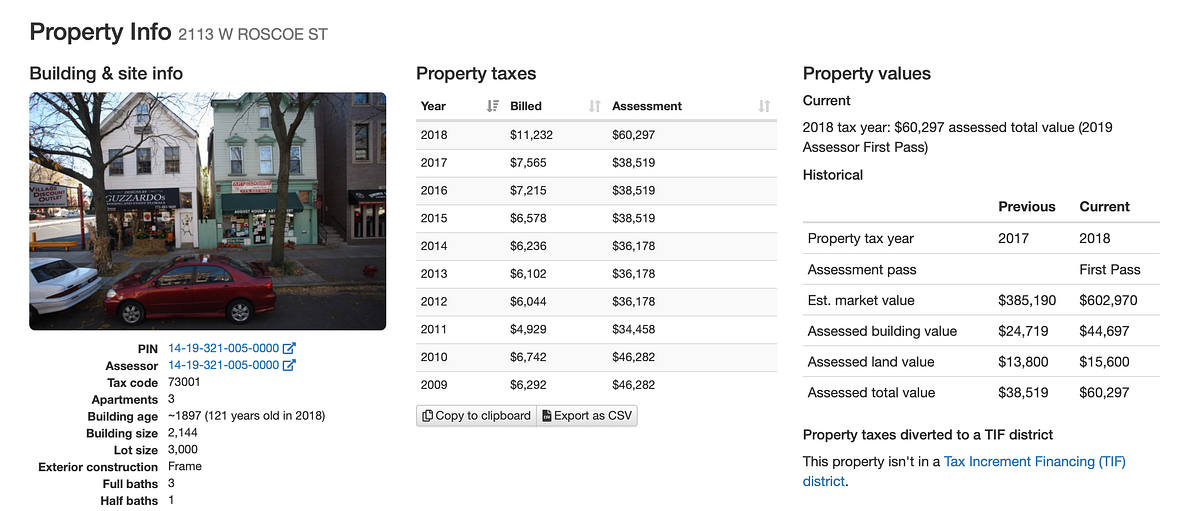
Bank loan officers, real estate agents, developers, and everyone else can find the updated information in the Address Snapshot report for a given address or PIN in Cook County. See the screenshot below.
Analyze the new data by area
With this information, you can research just how much the assessments at any given property, block, or neighborhood have increased or decreased. For example, the assessed value of property in the North Center community area increased from about $387.1 million to $474.5 million, a 22.6 percent jump for a gain of $87.4 million in assessed value. In East Garfield Park, on the other hand, the assessed value of property increased from $93.6 million to $100.3 million, a 7.1 percent jump for a gain of $6.7 million in assessed value.
Want to analyze the property on a single block? Draw a Personal Place.
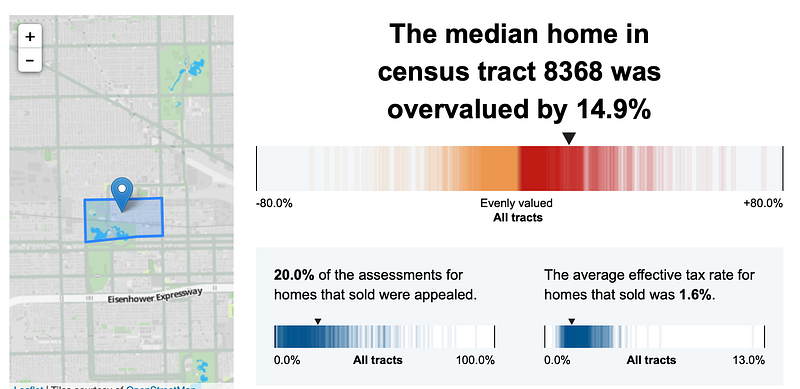
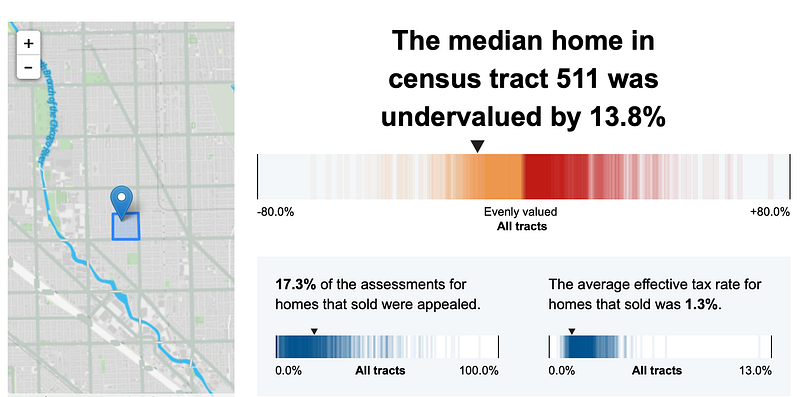
If you’ll recall from reading “The Tax Divide” in the Chicago Tribune in June 2017 — yep, it’s been two years since the assessment scandal was revealed — an increase in assessment doesn’t equate to an increase in taxes owed. How much property taxes are owed is based on a property’s assessed value relative to all other properties’ assessed values and how much levy each of the taxing authorities (City of Chicago, Cook County, Chicago Public Schools, Chicago Park District, etc.) are setting (their budgets).
If a property is under-assessed (meaning the Cook County Assessor is “valuing” it at less than it’s worth, and which the Tribune showed happened more often in areas with higher market value houses) in 2017 and then fairly assessed in 2018, that property may see a much higher tax bill. If a property is over-assessed (which the Tribune showed was happening in areas with lower market value houses) in 2017 and fairly assessed in 2018, that property may see a similar tax bill, a slightly higher tax bill, or even a lower tax bill.
In East Garfield Park, the average assessment for the 5,512 assessed properties increased by 13.1 percent from 2017 to 2018. In North Center, however, where there are many more higher-value houses which were under-assessed, the average assessment for the 11,222 assessed properties increased by 26.6 percent. This means that property taxpayers in North Center are now shouldering slightly more of Chicago’s property tax payments than before (relative only to the property taxpayers East Garfield Park).