Developers, property owners, and land use and zoning attorneys have a new tool on Chicago Cityscape at their disposal. Zoning Change Statistics answers the equestion, “How long will it take to get a zoning change approved in a particular ward?”
Every zoning change application must be passed and adopted by the Chicago City Council and its zoning committee.
These zoning change applications are shared as proposed ordinances on the Chicago City Clerk’s legislation website, hosted by Legistar. Another website, Chicago Councilmatic, makes proposed ordinances easier to search and provides a feed that Chicago Cityscape uses to calculate the approval rate of zoning change applications for all 50 wards.
For instance, in the 33rd Ward, Alder Deb Mell has approved 78 percent of the zoning change applications that were introduced in the last two years.

“Action” means they were either passed in the last two years, or they were introduced in the last two years and deferred (not passed).
That’s 21 zoning change applications that were passed out of 27 that were introduced in the last two years. Zoning changes are also approved at a slightly faster rate in the 33rd Ward as citywide.
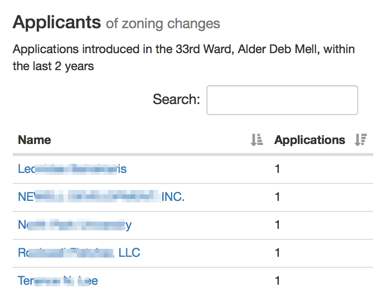
In addition to the approval rate statistics, we highlight the names of applicants, property owners, and their lawyers who are working to obtain the zoning change. This information comes from our own scouring of the application paperwork, as this information isn’t listed in any database.
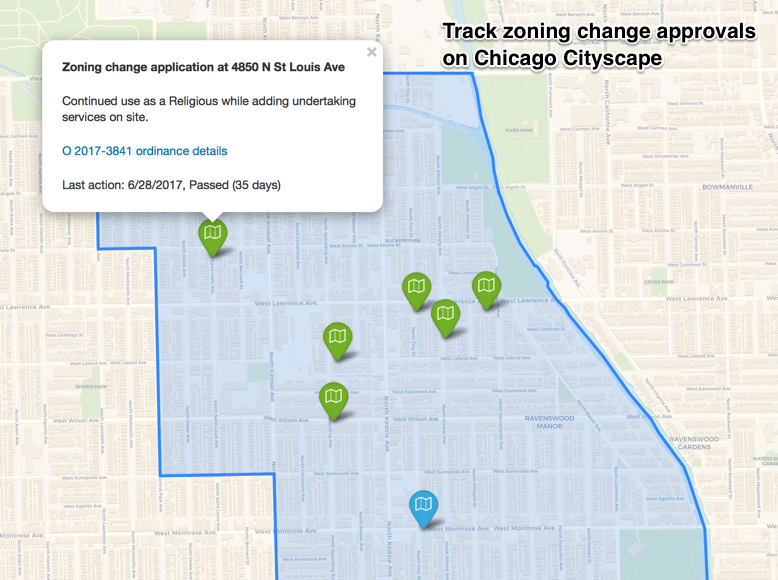
Finally, an updated map design (seen at the top) shows passed and non-passed zoning change applications.
What we’re reading
- Despite controversy in Pilsen over a developer’s proposal for new housing on a large vacant lot next to the Halsted Metra station, it’s unclear what role the Pilsen Land Use Committee really plays, in relation to Alder Danny Solis and what projects get approved and why (South Side Weekly)
- MAP Strategies defines what a “compliance partner” is and why developers who don’t have one are at a disadvantage
- Upcoming book by Daniel Hertz will document how gentrifiers of Lincoln Park in the 1960s actually wanted it to be a diverse place (Crain’s)
- Residents of Atrium Village in Old Town say that the developer that bought the affordable housing development, Onni, is backpedaling on its requirements and agreements (Chicago Reader)