The discussion of whether to allow zoning districts that ban multi-family housing is still hot across the United States, but no hotter than in conversation around SB50 in California. SB50 is a proposed legislation that would prevent municipalities from places limits on housing density below a certain amount near train and ferry stations and some bus routes. The legislation would also implement several protections to prevent displacement of people who rent their homes while also giving certain communities time to adopt their own legislation instead of SB50.
Part of the discussion, however, includes the role of limiting who can live in a community, and where, because of the prevalence of single-family zoning.
This blog has published maps showing how much of the zoned land area in Chicago bans the new construction of multi-family housing (that means no apartments, condos, or townhouses, and no affordable housing) — including near high-quality transit. Keeping zones single-family-only also prevents homeowners from making additions to their existing two-flats and three-flats.
How much of Chicago bans multi-family housing?
A lot, and the proportion depends on how you look at the different ways land is zoned in Chicago.
The “zoning department” (it’s actually a bureau within the Chicago Department of Planning & Development) maintains a zoning map in GIS that divides zoning districts (discrete areas of a specific zoning classification that covers one or more parcels) into 12 types. Six of these types allow residential buildings, including the “R” zones that allow residential buildings of varying degrees of size and density, and some other uses like churches and schools. The other types are all mixed-use: B and C (neighborhood business districts), and DX, DC, and DR (different kinds of downtown districts).
The City of Chicago draws its zoning map to include all land area, while many other jurisdictions draw their zoning maps to only include only parcel areas. This means in Chicago that zoning districts will overlap with streets and alleys. Therefore, the following statistics are not “buildable” area, but should be considered in proportion to other districts, assuming that most of our streets and alleys are generally the same size.
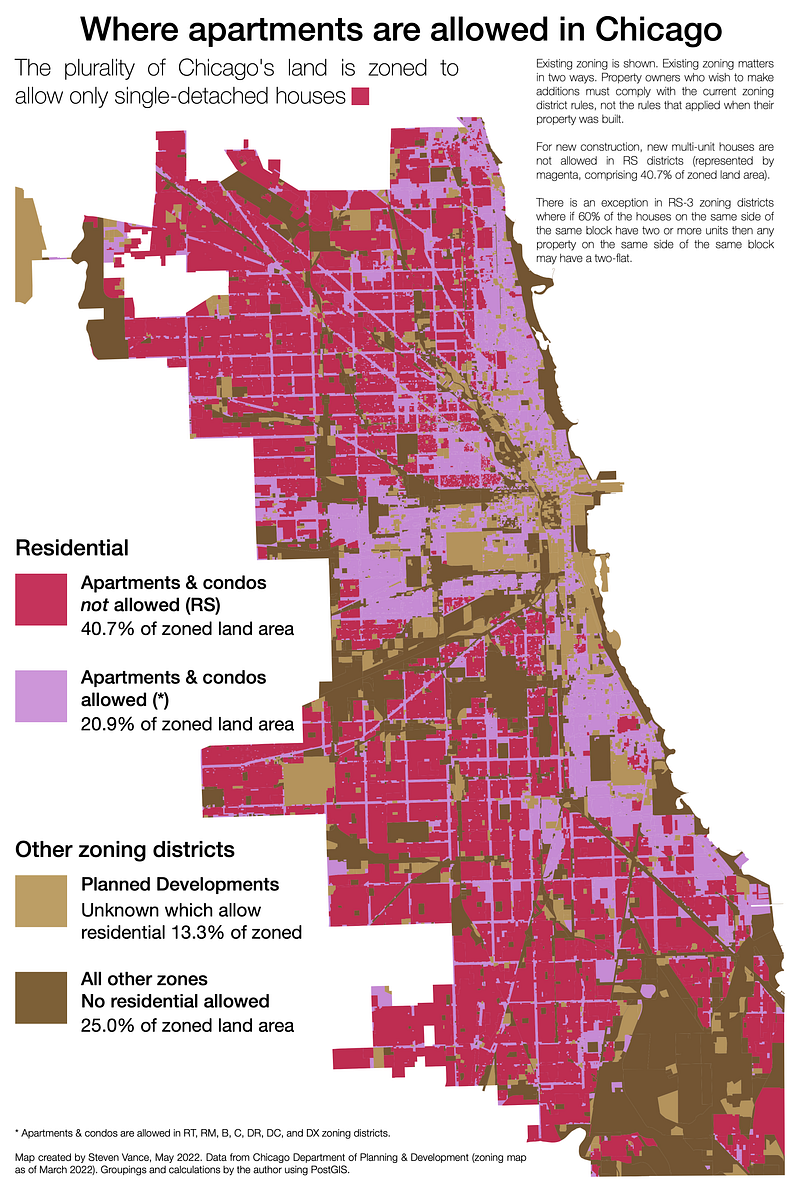
Zoned land area means the zones expand beyond parcels to include roads, so this map shows zones in proportion to each other rather than measuring land area without roads.
Across the City of Chicago, the six zoning types that allow residential uses comprise 62.0 percent of the zoned land area. (I’m excluding Planned Developments because I don’t know which ones allow residential uses. Planned Developments comprise 13.0 percent of the City’s zoned land area.)
Single-family is the only allowed use in fully 41.1 percent of Chicago’s zoned land area. Multi-family housing is permitted in about 20.8 percent of the city’s zoned land area.
Of the 62.0 percent of Chicago’s zoned land area that allows residential uses, 66.5 percent of that area bans multi-family housing — condos, townhouses, apartments, and affordable housing.