Mayor Emanuel introduced a new ordinance (O2017–4840) at Wednesday’s City Council meeting that would change the zoning in the North Branch Industrial Corridor (NBIC), which contains four Planned Manufacturing Districts that currently forbid residential uses.
Update: The plan was approved at the July 26, 2017, City Council meeting.
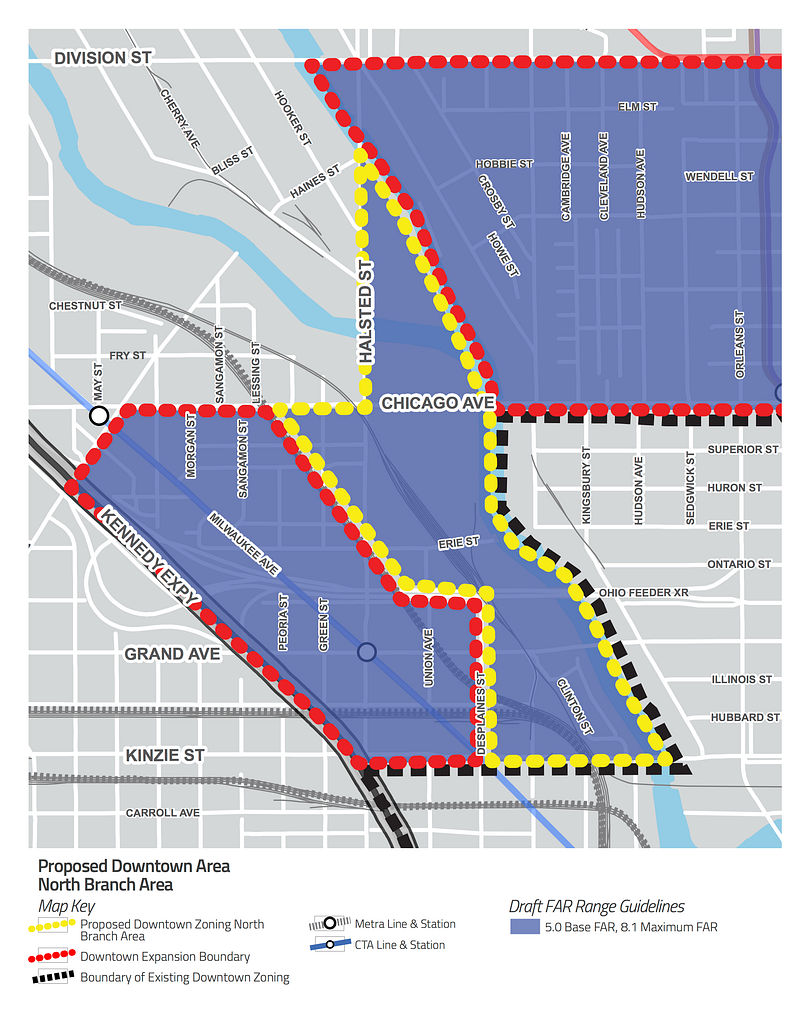
One of the PMDs (Clybourn-1) would be dissolved. Two other PMDs (Elston-2, Goose Island-3) would have truncated boundaries. The fourth PMD (Chicago/Halsted-5) would have severely truncated boundaries. Future commercial and residential uses would be allowed in some parts.
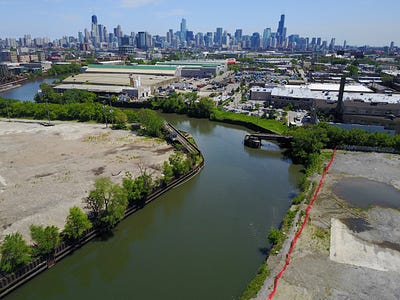
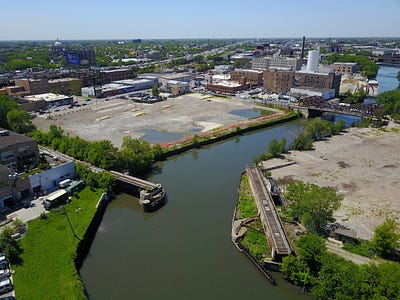

Back to pre-PMD zoning
The ordinance creates an overlay district with three subdistricts. Two of the three subdistricts would allow parcels within the PMD to change to new zoning districts. No parcel can be changed to R (residential only).
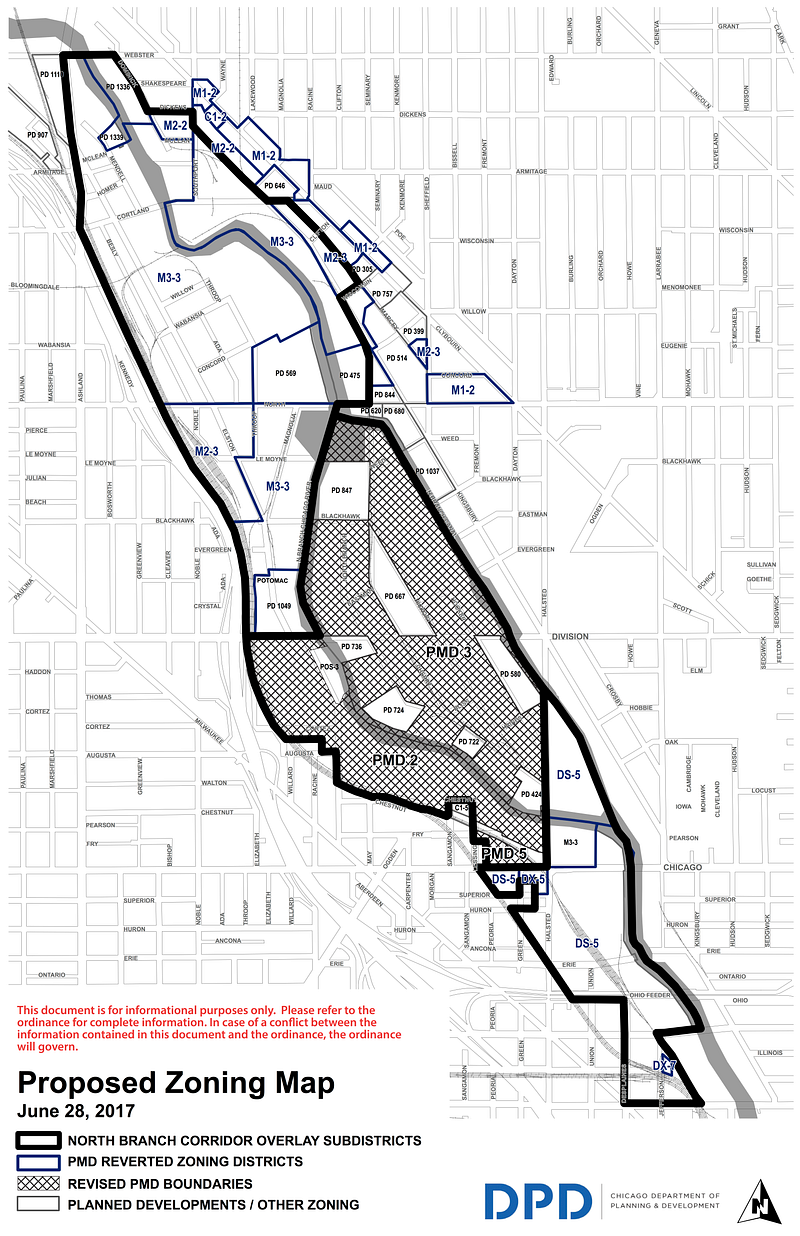
Parcels in subdistrict “A” (the northern one) would revert to M or C and can be changed to B, C, POS (public open space), or T (transportation) zoning districts, both of which allow residential uses.
Parcels in subdistrict “B” (middle) would revert to M districts and can only be changed to other M districts.
Parcels in subdistrict “C” (southern) would revert to DS (downtown service) and DX (downtown mixed-use) and can only be changed to DX, POS, and T zoning districts.
DS districts don’t allow any residential use, but they allow hotel and motel uses.
Skip to the last section to read about how the Finkl Steel and nearby sites are affected.
Rezoning fee
Developers who rezone a property in majority portions of subdistricts “A” and “C” to a B, or a different C or D zoning district would have to pay a conversion fee (see yellow shaded areas on the map).
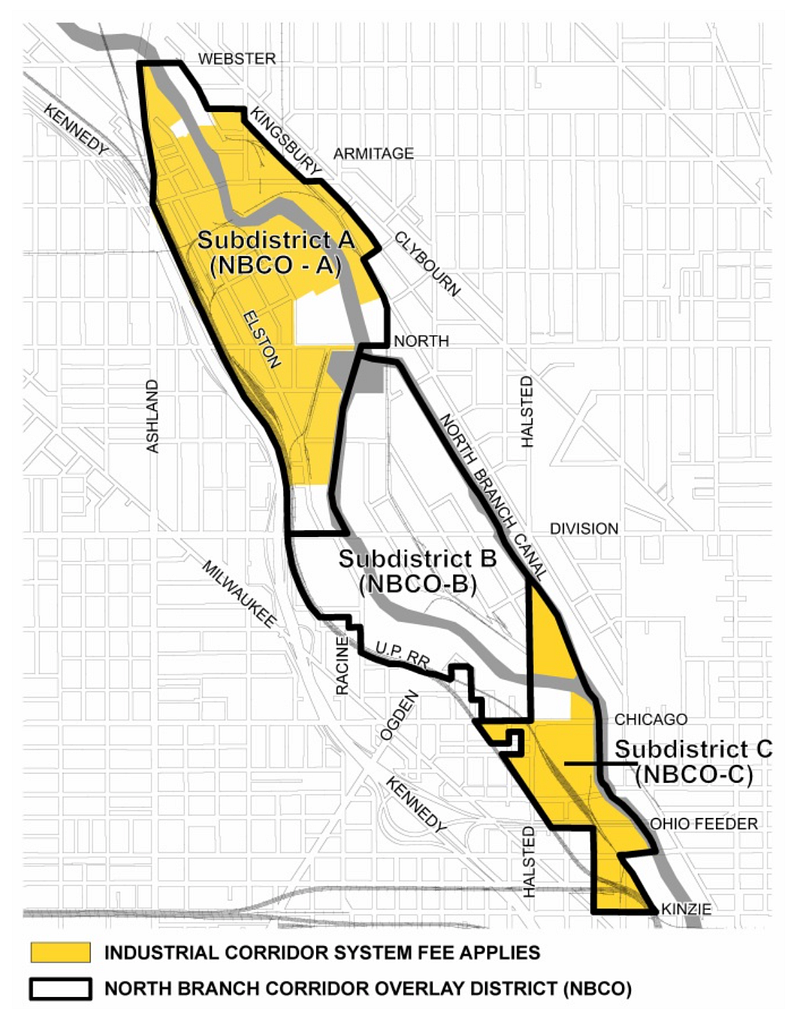
The conversion fee formula is based on the property area, the median citywide industrial land acquisition cost, the average building rehab costs, environmental remediation, street rehab, and site prep costs. This is currently estimated at $49 per square foot. Multiply that by the area and the developer must pay 25 percent of that.
Planned developments are allowed in all three subdistricts; this process remains largely the same, if not the same, in the NBIC.
Funds from the conversion fee can be spent in most of the other Industrial Corridors. They cannot be spent in the NBIC, Addison, and Ravenswood Industrial Corridors.
Density bonuses
Property owners can purchase floor area (FAR) bonuses.
In subdistrict “A”, which doesn’t have any D zoning districts and isn’t in the downtown expansion area, there is still a way to buy additional density called the FAR bonus. The bonus is available to parcels zoned B-3 or C-3.
The bonus is a bit cheaper than the NOB. Also different is where the funds go: 70 percent of the funds are designated for public improvement projects that further the goals of the North Branch Framework plan, and 30 percent of the funds are designated for projects in the 25 other Industrial Corridors.
Parcels in subdistrict “B” cannot exceed the maximum floor area ratio of 3.0. There are no bonuses in “B”.
The ordinance would extend the Neighborhood Opportunity Bonus (NOB) system to parcels in subdistrict “C” that are zoned DX-5.
What happens to the former Finkl Steel site?
The properties of the former Finkl Steel factory, and the Lakin tire recycling and Sims metal recycling plants revert to M3–3 zoning in subdistrict “A”. These parcels can be rezoned to B or C zoning districts, and would be subject to the conversion fee. The developers could buy additional density through the new floor area bonus program.
The B and C zoning districts allow residential. Unfortunately they also allow single-family residential.
Further reading
Our summary was derived from the ordinance text and various maps and overview documents that the Chicago Department of Planning & Development published today.