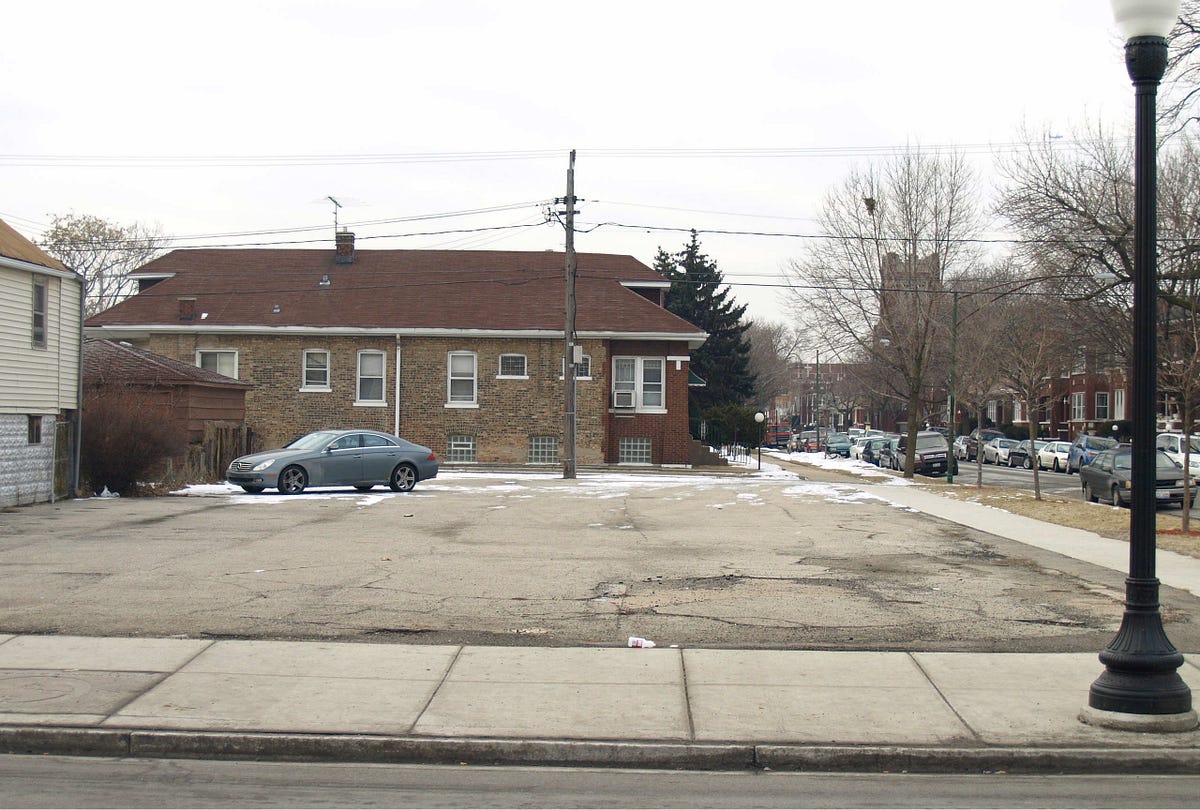
The Large Lots application process is now open to residential property owners in parts of Chicago, who are eligible to buy city-owned vacant lots.
There are 3,844 vacant lots for sale in 34 community areas. You have to own residential property on the same block (including across the street or alley) to be eligible. You can’t owe the city any debt or have outstanding tickets.
You’re allowed to build an addition to your own home, a new home, a new multi-unit apartment or building (depending on the zoning district of the lot), or landscape it or create a community garden. If it’s adjacent, you don’t have to bother fencing it.
Most of the lots — 67 percent of them — only allow a single-family home to be built.
But! There are 1,256 lots on which you can build a multi-unit building. Of these 1,256 lots, you can build only up to a 2-flat on 1,066 of them. The remaining 190 lots, however, are zoned RM-5 (188) and RM-6 (2) which allows you to build as many units as the zoning district allows, based on size of the lot, required setbacks, and the minimum floor space required per unit.
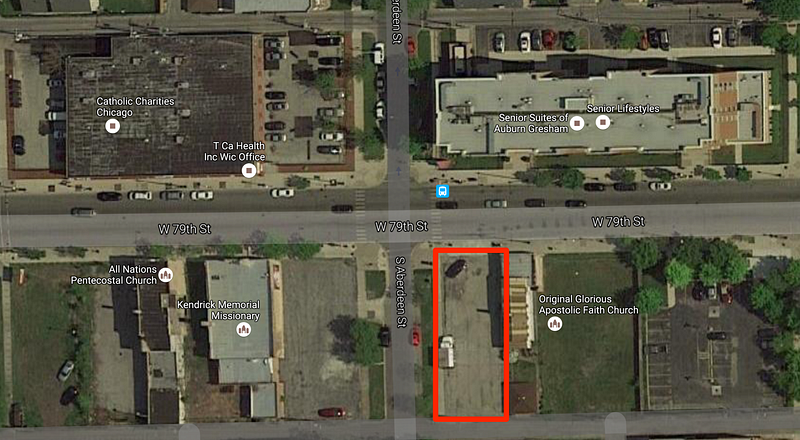
On each of the two lots zoned RM-6, both in Auburn Gresham, for example, you could build about 4 floors, each with several units as small as 300 square feet. The two lots are adjacent, on the corner, currently serve as a parking lot, and are on the 79th Street commercial corridor, along the city’s busiest bus route. (I hope that in this situation the same person applies and receives both lots, so there’s a single owner instead of one.)
This is a great location for multi-unit residential. A Catholic high school is a couple of blocks away, as are two major convenience stores, a bank, and a Sav-A-Lot grocery store. Compared to some of the other neighborhoods with vacant lots that are part of Large Lots, this part of Auburn Gresham has relatively few vacant lots. A senior living building and a Catholic Charities office is across the street.
There isn’t evidence yet that any Large Lot owners from the previous programs have built on their new land. An upcoming study from researchers at the University of Illinois and Urbana-Champaign and the National Forest Service found that a large majority of lots were being mowed (some even before acquisition), fenced, and there was an increase in gardening activity.
The researchers, William Stewart and Paul Gobster, presented initial findings at the“International Symposium on Society and Resource Management” in the summer. They wrote:
Across the two years of study, 40% of large lot owners made changes in the first season. These changes included cleaning-up trash and refuse, installing fences, infill of subsidence, hardscape removal, turf improvements, planting (flowers, vegetables, trees, and shrubs), putting-up signage, ornamentation, development of social/recreational facilities, and vehicle storage or parking.
Stewart and Gobster also interviewed owners on their visions for lot development. These plans were organized into themes about beautifying the block, growing food, and affirming “family identity” in the neighborhood.
How amazing would it be that a lot that’s been vacant for many years could be turned into a multi-unit residence with a local property owner as the landlord? Land is a major cost in building something new, but that has essentially been made free through Large Lots.