
Earlier this week the Chicago Sun-Times reported that the city had collected nearly $4 million from downtown property developers into the Neighborhood Opportunity Fund. Developers can buy increased FAR (floor area ratio) to build taller or denser buildings through the Neighborhood Opportunity Bonus program that replaced, in June 2016, the existing bonus program that installed mediocre public amenities in exchange for more FAR.
Eighty percent of the fee for FAR goes into the NOF; 10 percent goes to pay for a local impact project, and the other 10 percent goes into the city’s adopt-a-landmark fund, or a specific landmark near the building.
The Neighborhood Opportunity Fund will eventually collect $11,071,404.19 for just the 13 residential and commercial projects approved so far.
The local impact and landmark funds each have $1,383,925.52. This information comes from the Department of Planning & Development’s tracking spreadsheet I requested after reading the Sun-Times’s report.
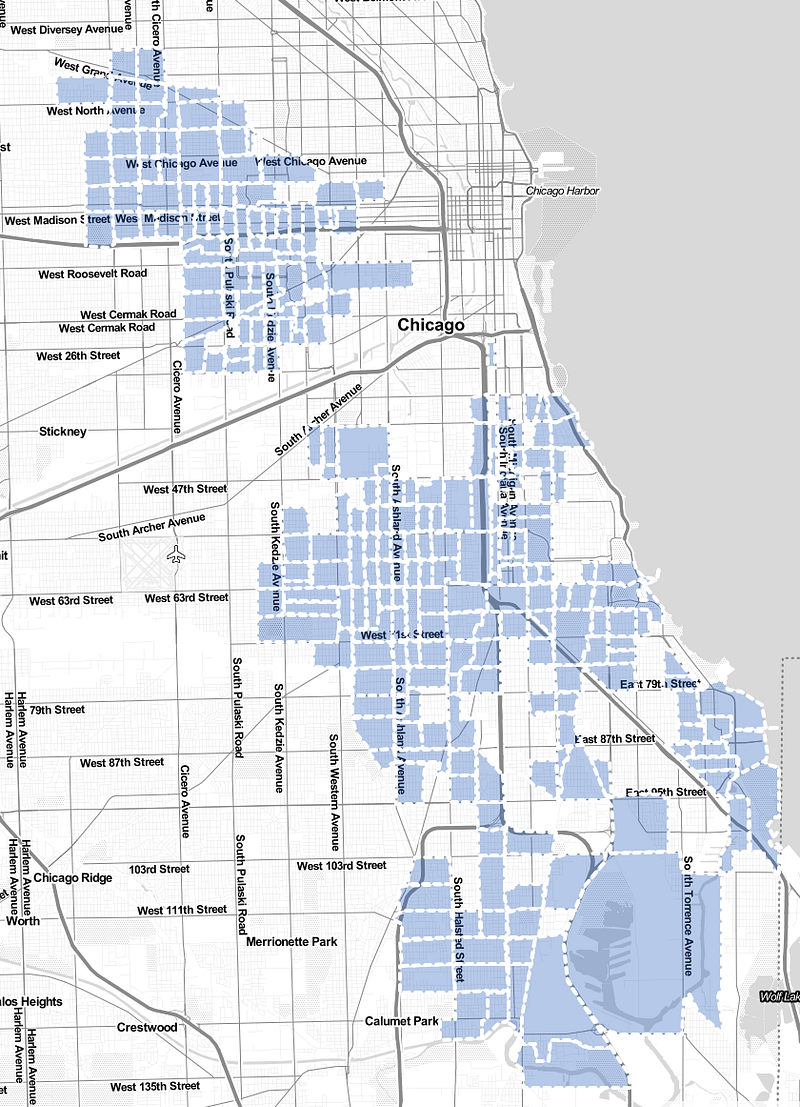
NOF money will be used to make grants to businesses in “investment zones” — these are mapped on Chicago Cityscape, and reported on each Address Snapshot report.
Applications for grants that can cover up to 65 percent of costs will open on Monday, February 27th. The mayor’s office and planning department have authority to bestow grants up to $250,000, above which the City Council will have to approve.
This money was contributed by the developers who are constructing 13 buildings in Downtown-designated zoning districts, and in the downtown expansion areas that allow a developer to apply for a D-district in areas currently zoned B and C. We recently added a new designation in Address Snapshot that tells you if a property is in the downtown expansion area, or not.
Where are the buildings
Eight of the 13 buildings are in the 27th Ward (Alder Burnett) and one of those eight is shared with the 25th Ward (Solis); two are in the 42nd (Reilly), two are in the 2nd (Hopkins), and one is in the 3rd (Dowell).
What I found more interesting about these contributions and the benefits received was that developers paid different prices for each square foot gained. The range was $18 to $34 per additional square foot.
- 716–42 N Aberdeen St & 721–39 N Ogden Ave (residential)
$888,938.20 - 200–10 N Carpenter St
$1,992,044.80 - 57–61 W Erie St
$250,019.00 - 900–10 W Washington Blvd
$263,900.00 - 1115 W Washington Blvd & 19–27 N May St
$488,267.20 - 801 W Lake St
$2,397,557.60 - 100–10 W Huron St
$148,601.00 - 901–05 W Fulton Market
$721,848.00 - 215 W Hubbard St
$417,581.60 - 1354–1408 S Wabash Ave (residential)
$1,030,374.40 - 854 W Randolph St (NoBu Hotel)
$875,769.84 - 9 W Walton St (residential)
$766,776.00 - 110 N Carpenter St (McDonald’s headquarters)
$3,597,577.60