The City of Chicago supports the construction and maintenance of affordable housing through direct funding, financing, and regulations — that’s “Affordable housing” with a capital “A” because there are rules that define what kind of rental and sale prices constitute affordable. The Chicago Department of Housing tracks the location of these affordable dwelling units and recently enhanced their version of the data on the City’s data portal.
We’ve also integrated that improved dataset of affordable apartment buildings across Chicago Cityscape.
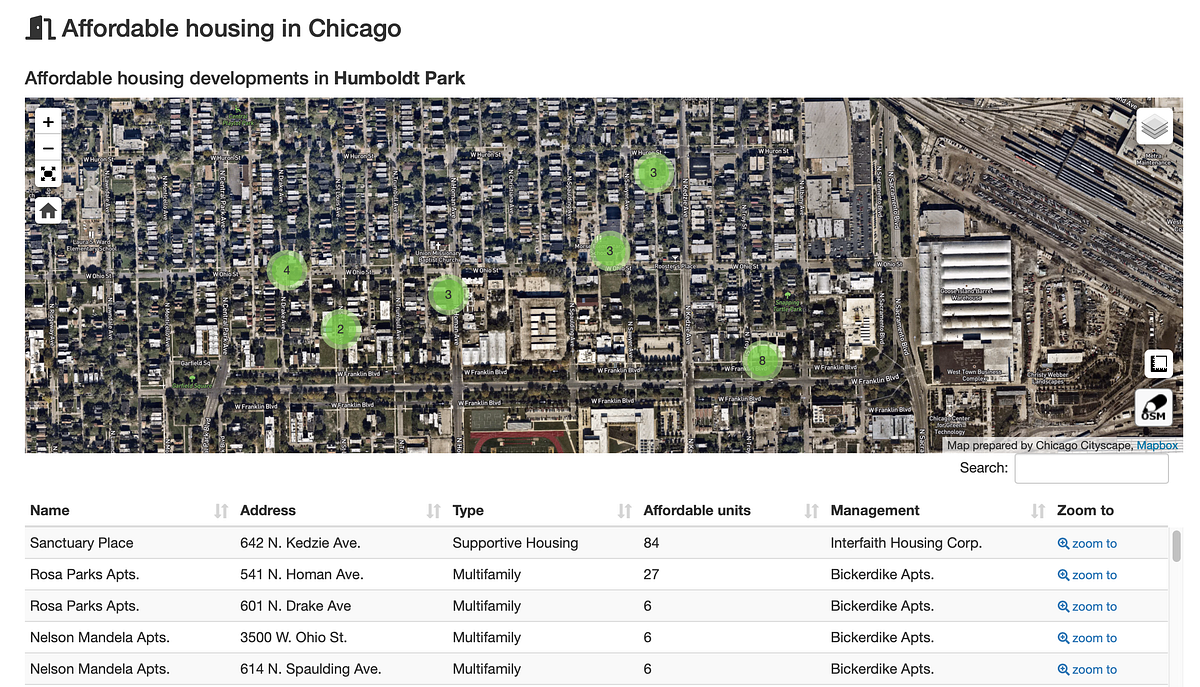
Recently, the City added the location of residential units that were constructed by property owners to comply with the Affordable Requirements Ordinance, or ARO, which added about 200 more buildings to the dataset.
The ARO, generally, requires that builders set aside 10 percent of the new or added units as Affordable for 30 years if the builder receives a zoning change in order to build or add 10 or more units.
The location of ARO and units funded through other means (like the Low Income Housing Trust Fund or TIF) is important to track compliance over the duration of the funding for those residences, and to help residents find known affordable housing. Naturally occurring affordable housing’s location isn’t tracked by any local organization officially, except when it’s disappearing.
How to find affordable housing on Chicago Cityscape
There are two ways to use Chicago Cityscape to find the location of the affordable that the Chicago Department of Housing (DOH) tracks:
- Look up an address and find developments within a couple of blocks.
- Look up a Place and find all of the developments within that Place. Places include community areas, voting precincts, Census tracts, wards, TIF districts, and dozens of other types.
Cityscape Pro members and those who’ve purchased the relevant Address Snapshot report are able to download the data as a map or spreadsheet file.
There’s also small “a” affordable housing which is unsubsidized housing that’s affordable and attainable; sometimes called naturally occurring affordable housing (NOAH). This kind of housing isn’t tracked and data that can be used to analyze where it exists is often a year or two delayed, which may not be useful to people looking for places to live. The data is useful to track which places are becoming less affordable, something the Institute of Housing Studies does well.
Ways to fund affordable housing in Chicago
Not all of the funding mechanisms listed below include City money, but the Department of Housing can assist housing developers navigate the complicated financial options. The list was derived from the most recent quarterly housing plan update.
- Tax Increment Financing (TIF); this is geographically based
- Loans
- Low Income Housing Tax Credit (LIHTC)
- Illinois Affordable Housing Tax Credit (IAHTC); any organization that owes an Illinois income tax can make a donation to an affordable housing project in exchange for a tax credit worth half the donation
- Multi-family housing revenue bonds; tax-exempt bonds are sold on behalf of housing developers at a low interest rate
- Chicago Low Income Housing Trust Fund (LIHTF)
- Troubled Buildings Initiative (TBI)
- TIF Neighborhood Improvement Program
- Historic Chicago Bungalow Initiative
- Neighborhood Lending Program; downpayment and closing cost assistance administered by Neighborhood Housing Services (NHS)
- Affordable Housing Opportunity Fund (AHOF) and Multi-year Affordability through Upfront Investment (MAUI)
- Affordable Requirements Ordinance (ARO