City Council to review revised ADU ordinance to apply in pilot areas only
Published on Dec. 12, 2020 by Steven Vance
Updated on Dec. 18, 2020
City Council will review revised ADU ordinance to apply in pilot areas only
The ordinance was adopted on 12/16/20. Read our new FAQ.
On Tuesday, December 15, 2020, Chicago’s zoning and housing committees will receive a revised version of the accessory dwelling units (ADU) ordinance that was proposed in May. The ordinance was heard at a July committee hearing, and held on ice since then. The revision makes some steps forward and some steps backwards.
My summary is based on a report in The Daily Line, and other sources — I haven’t seen the revisions myself, and they’re subject to change up until the committee meeting on Tuesday. Let’s jump right in.
The good (and kinda great)
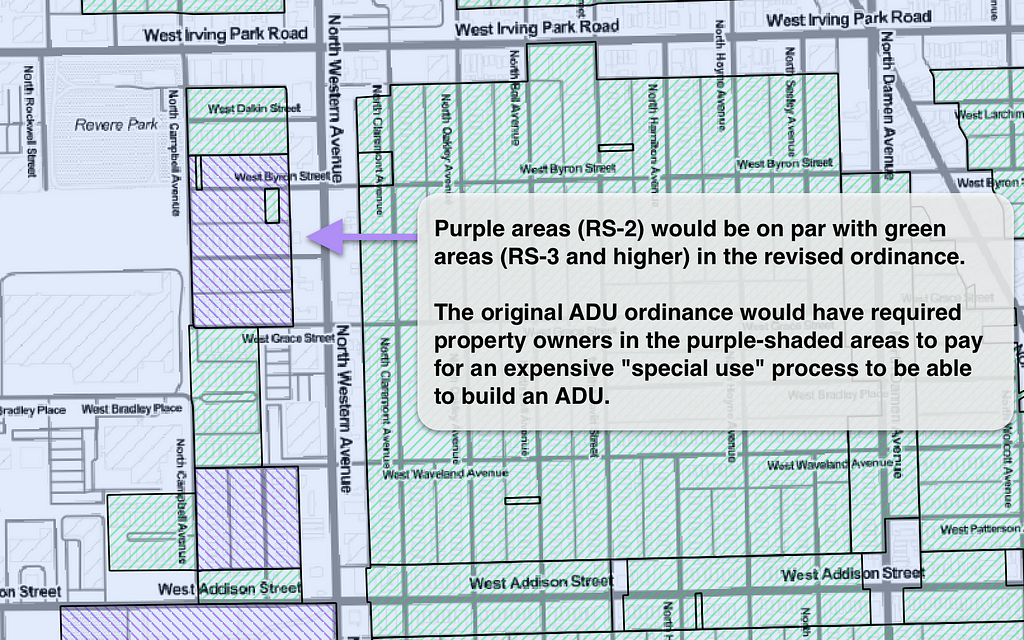
- The revision would make ADUs an “as of right” option for people (like Carmin) who have property in RS-2 zoning districts, expanding the eligibility area. Excluding property owners in RS-1 and RS-2 zoning districts from the privilege of building housing for their own families was my primary concern. 🙌🏽
- Money from Chicago’s Low Income Housing Trust Fund (LIHTF)would be set aside to support the rents of very low income households to live in interior ADUs. This will guarantee reliable rent for the ADU owner. 😎
- The Department of Housing will fund a grant program to subsidize the design and construction of interior ADUs for low to moderate income homeowners. 🥰 (Update: This would be funded by ARO in lieu fees.)
The bad
- The option to build an ADU is completely taken away from those in RS-1 zoning districts; before, it would have been an option via the “special use” procedure at the Zoning Board of Appeals. (There are no RS-1 zoning districts in the pilot areas.)
- The revision removes the ability to build a backyard house on a vacant lot prior to the construction of a principal house. Read more about this issue.
- Residential-only buildings in B and C zoning districts are still not included.
The ugly is the patchwork of location rules
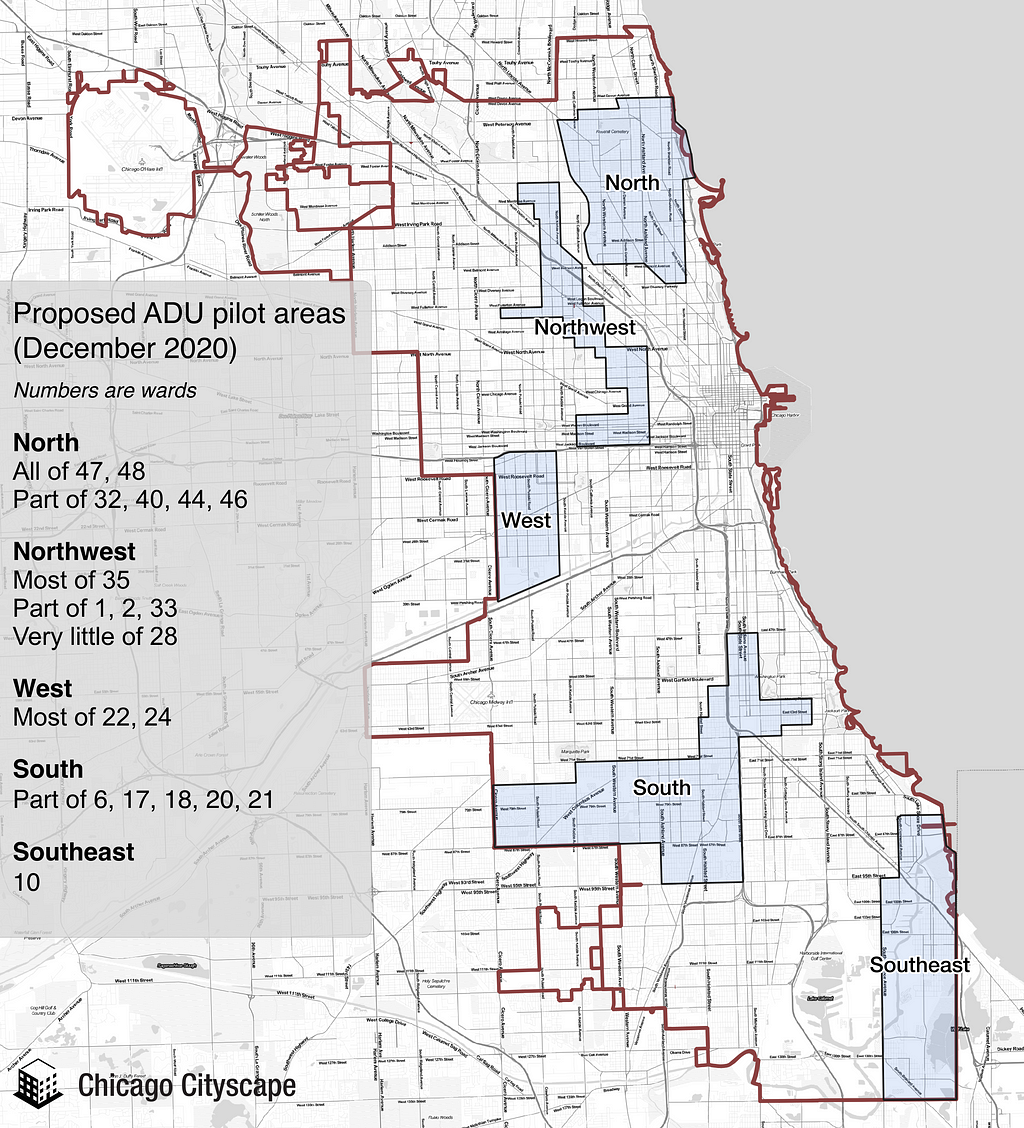
- This map that has been drawn to include all or part of the wards represented by alders who support accessory dwelling units and to exclude the wards of those who don’t.
- West, South, Southwest zones: Only two ADUs per block per year would be permitted. There are two block sizes in Chicago: 330 feet and 660 feet. This rule puts those on the longer blocks at a disadvantage because there is more competition. (I think this will add some bureaucracy, when the buildings and planning departments have to check which ADU building permit applications are in the review queue and who else on the same block is also applying for an ADU building permit — who gets the two permits when three people are applying for one?)
- West, South zones: Backyard houses could only be built on owner-occupied properties.
Several rules were reported to stay the same since May (read that FAQ):
- Backyard houses and interior ADUs could only be built in R zoning districts.
- A backyard house cannot be built on a property with an interior ADU
- ADUs could not be listed on short term and vacation rental websites
- Interior ADUs could only be added to buildings that are 20 years old or older
- When building two or more interior ADUs half must be rented at an affordable price (capped at $1,100 for a one bedroom in a basement)
- Bulk and density limitations are the same (700 s.f. maximum, 22 feet tall)
Look up your zoning district with Chicago Cityscape’s Address Snapshot.
Here’s my cynical view of the revision: I thought that Chicago wanted to repopulate, encourage people to build homes for their parents and their children, let the private housing market provide unsubsidized affordable housing, and reuse vacant land by allowing new small and lower-cost housing.
Instead City Council is going to adopt a policy that changes the look of the barriers in the original proposal and create a geographic patchwork of rules, privilege first adopters (people who are ready to get permits) in part of the already-limited area of eligibility, and ensure many vacant lots persist.
I believe that City Council can augment the policy as time goes on, and I have faith that the staff I know in City Hall, and the community advocates who have been asking for basement units to be legal, intend to do so.
I understand that this is the compromise that was needed to get it passed, and re-legalize a historic practice. Every city and state — remember, ADUs are legal in all of Washington, Oregon, and California — that has legalized this kind of housing has gone through many changes for years until it found a framework that actually supported the significant addition of new housing and housing options.
The ordinance proposed back in May was a good attempt at bypassing the need for countless revisions. This version does not do that.
City Council to review revised ADU ordinance to apply in pilot areas only was originally published in Chicago Cityscape on Medium, where people are continuing the conversation by highlighting and responding to this story.
Other posts by Steven Vance full archive