Chicago will allow ADUs starting in May — Read our FAQ
Published on Dec. 15, 2020 by Steven Vance
Updated on May. 25, 2021
Chicago will allow ADUs starting in May — Read our FAQ
The joint committee on Housing and Zoning heard a revised ADU ordinance on Tuesday, December 15, 2020. The “substitute” ordinance was adopted on Wednesday, December 16, 2020, by a vote of 22 to 1 (15th Ward Alder Raymond Lopez voted against).
This is a new FAQ, but I recommend that you open the May 2020 FAQ in another tab as this FAQ tends to avoid repeating regulations that didn’t change. Additionally, we have a new ADU portal and explainer video.
- Where can I download the adopted ordinance?
The ordinance is O2020–2850. Get it from the City Clerk’s website, but download the SO2020–2850 file (to get the substituted ordinance).
2. When can the first ADUs be permitted?
Building permit applications can be submitted as soon as May 1, 2021.
For those property owners who use a self-certified architect to design their ADU, a permit could be issued within a couple of days. Ask your architect if they’re “self-certified” with the Chicago Department of Buildings.
3. Where will ADUs be allowed?
The revised ordinance will allow backyard houses and interior ADUs in RS-2, RS-3, RT-3.5, RT-4, RM-5, RM-5.5, RM-6, and RM-6.5 zoning districts. No ADUs will be allowed in RS-1, and there is no zoning relief for this.
The property must also be within one of the five pilot areas, officially called “Additional Dwelling Unit-Allowed Areas”.
Look up your address on Chicago Cityscape to see if your property is in the right zoning district ↔️ pilot area combination.
4. How many ADUs can I build on a property?
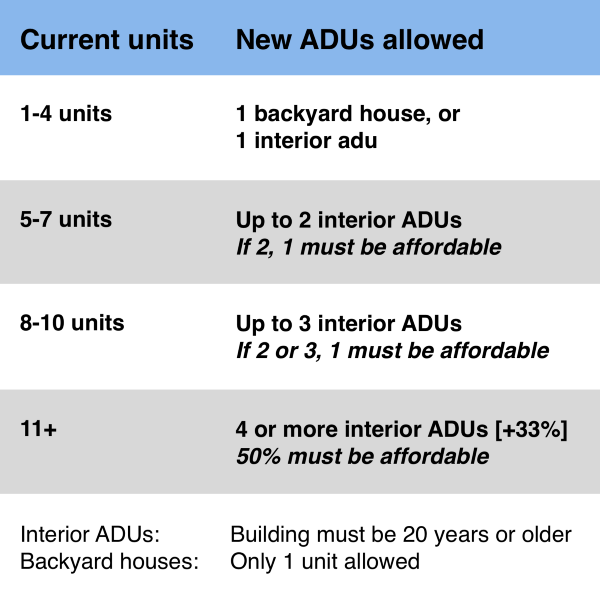
If a building has 1 to 4 units, it can have a backyard house or an interior ADU. If it has 5 or more units, it can have at least two interior ADUs; backyard houses are not allowed at buildings with 5 or more units.
The original proposal that a building can add 33 percent units as interior ADUs, and that it has to be 20 years old or older, has not changed.
The chart breaks down the number of units for each size of residential building. (The chart was adapted from a Chicago Department of Housing presentation to City Council.)
5. What are the affordability requirements?
The affordability and registration requirements have not changed; see the May 2020 FAQ. Generally, half of the interior ADUs added have to be rented at affordable rates set by the Chicago Department of Housing annually.
6. Are there additional regulations specific to some of the pilot areas?
Yes. The West, South, and Southeast areas are in a group that has additional regulations.
- Vacant lots cannot be developed with a backyard house before a principal house is built.
- Buildings with 1-3 units must be owner-occupied in order to have a backyard house or an interior ADU.
- No more than two properties per block (both sides of the street between intersecting streets) can get an ADU permit per year.
7. How big of an ADU can I build?
Interior ADUs: Generally, interior ADUs can be created out of any subdivided space within the building’s existing envelope. If an addition is desired that would expand the envelope (either in the rear, side, or another floor), then the FAR and setbacks need to be calculated. Chicago Cityscape or an architect can do this.
Backyard and coach houses: The floor area is limited to 700 s.f. The zoning code doesn’t define “floor area” so use the zoning code’s definition of Floor Area Ratio to determine what counts as floor area.
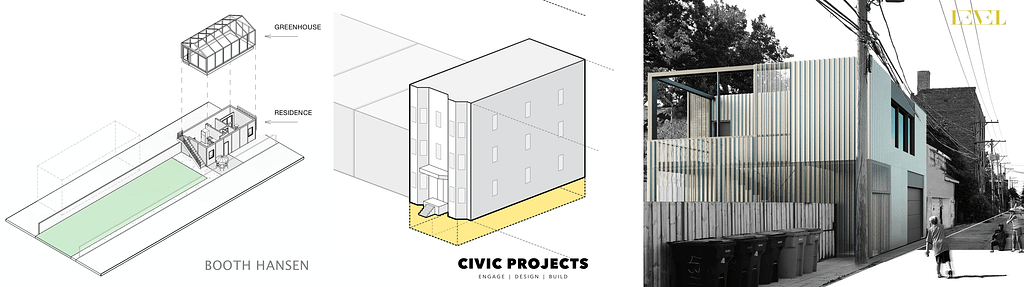
The combined footprint of all accessory buildings (garages, backyard houses, sheds, etc.) cannot exceed 60 percent of the required rear setback. Review Booth Hansen’s zoning worksheet on how to calculate these maximums for backyard houses, or read the list below:
- Standard lot size (25' wide by 125' deep): The required rear setback is 28 percent of lot depth, or 50 feet, whichever is less. 125*.28 = 35' is the required rear setback depth. Multiply 35' by 25' to get the area: 875. Multiply 875 by 60 percent to get the maximum footprint area: 875*.60 = 525 s.f.
- 1.5x wide lot (37.5' wide by 125' deep): 125*.28 = 35. 35*37.5 = 1,312.50. 1,312.50*.60 = 787.50 s.f. maximum footprint — but remember that the floor area is limited to 700 s.f.
Backyard house design tip #1: Consider placing a staircase on the exterior of the backyard house, which is allowed to be in the required rear setback and does not count against the above maximums.
Backyard house design tip #2: Increase the floor area beyond the footprint by building a loft or mezzanine space.
8. Who can design or build an ADU for me?
A lot of people and companies have added themselves to the Chicago Cityscape ADU Service Provider directory.
9. Can I build a ground level garage and a separate ground level backyard house?
Maybe. A new regulation was added to the revised ordinance saying that “the combination of all accessory buildings may not occupy more than 60% of the area of a required rear setback.” Both a garage and a backyard house are accessory buildings. The previous version didn’t have this regulation.
10. Is the parking requirement in RS districts still being reduced to 1?
No. This section was removed in the approved ordinance. Keeping the current off-street car parking requirement in RS districts at 2 will make it impossible to use ground level space for a backyard house on a standard-width lot (25 feet wide). That means accessible backyard houses will only be possible on lots about 37.5 feet wide or wider.
The original proposal reduced the requirement to 1 parking space per unit, allowing homeowners to reduce the number of spaces from 2 (for a single-detached house in an RS district) to 1 and using that extra ground level space to build the backyard house.
11. Do I have to tell my neighbors that I’m building an ADU?
Yes, and this courtesy is a new regulation compared to the original proposed ordinance. “Prior to issuance of a building permit…the permit applicant must provide written notice to abutting property owners and to the local alderman.”
The exact means and method hasn’t been established; most building permit notifications are provided via certified mail. The ordinance further stipulates that “[t]he applicant must submit a written affidavit certifying compliance with the notice requirements with the permit application.”
12. Are solar panels allowed?
Yes. Solar panels are allowed on accessory structures, including backyard houses, but they cannot exceed the 22' height limit above grade for rooftop features, and there is no relief for this like there is for garages.
Make sure you tell your architect your desire to have solar panels so they can design a spot where the panels won’t exceed 22' above grade.
Relatedly, the maximum building height of 22' is measured the typical zoning way, as described in 17-17-0311.
13. It seems like a bunch of regulations haven’t changed, what else is there?
- ADUs permitted through the ADU ordinance (in contrast to being permitted after a zoning change) cannot be used for vacation rental or shared housing.
- A property cannot have both a backyard house and an interior ADU permitted through this ADU ordinance. Not all property owners need to use the ADU ordinance to build an additional unit; one of Chicago Cityscape’s Property Finder maps shows thousands of properties that don’t have as many units as their zoning district and lot size allow.
- A backyard house cannot be built on a property with more than four units.
- The side separation requirement is still 3', clear from the ground to the sky, on one side.
- Minimum lot area per unit standards don’t apply.
- Floor area ratio (FAR): If expanding a building to accommodate an interior ADU, FAR limitations applies. FAR also applies to non-conforming buildings. For example, if there’s a three-flat in an RS-3, it likely exceeds the allowable FAR of RS-3 zoned lots, and thus is non-conforming. Adding an interior unit may not change the current FAR but non-conforming buildings are not allowed to increase the extent of non-conformity, as adding a unit in RS-3 would do. Another example: Single-unit houses on RS-3 lots may be at the maximum FAR and thus the ADU ordinance compliance route would mean subdividing the house.
14. What can I do if my property is in the right zoning district but outside a pilot area?
Contact your alder and tell them what your housing needs and goals are.
Plus, there might be another way, depending on your lot’s size and zoning district. Read this blog post if your property is in an RS-3 zoning district. If it’s in another zoning district, contact an architect or Chicago Cityscape to get a zoning assessment and customized strategy.
15. What are the fees to permit an ADU?
There are multiple possible fees, but it starts with the building permit fee (this goes to pay for the different staff who will review the application and plans):
- $375 deposit before building permit application review (which is applied to total fee)
- $1,575 overall for single interior ADU
- $2,075 overall for new backyard house
There may be other fees. The Department of Planning & Development assesses an Open Space Impact Fee (OSIF) per unit and can be reduced if the added unit is affordable or if there is significant on-site open space.
There is a water service permit fee if the property owner is repairing or replacing water service from the street to the building or meter. The city has a new program to to waive the fee if the water service line is made of lead and the property owner initiates the replacement.
There is a sewer work permit fee if the property owner is performing sewer work between the principal building and the street or the principal building and a backyard house.
There may be utility charges for new or relocated service from ComEd for the electricity and PeoplesGas for methane gas. There may be a public way permit fee (although I don’t know what for).
Chicago will allow ADUs starting in May — Read our FAQ was originally published in Chicago Cityscape on Medium, where people are continuing the conversation by highlighting and responding to this story.
Other posts by Steven Vance full archive