Cityscape has the maps you need to locate where new ARO rules apply
Published on Sep. 11, 2021 by Steven Vance
Updated on Sep. 30, 2021
City Council adopted a new version of the Affordable Requirements Ordinance (ARO) earlier this year, establishing “ARO 2021”. The rules goes into effect for most residential projects that are granted a zoning change on or after October 1, 2021. The basic trigger for requiring ARO compliance hasn’t changed: a residential development that builds or substantially rehabs 10 or more dwelling units, uses TIF money, or is built on city-owned property.
After the trigger, however, the ARO 2021 rules are drastically different than the ARO 2015 rules. First of all, the Near North/Near West and Milwaukee Corridor pilot areas, established in 2017, and their unique rules are eliminated for new developments.
Secondly, whereas ARO 2015 had three area types, ARO 2021 divides Chicago into five types of areas:
- Downtown. These are the existing downtown “D” zoning districts, plus properties in the Downtown Expansion Area that are rezoned to “D”.
- Inclusionary Areas
- Community Preservation Areas
- Low-Moderate Income Areas
- Pilsen and Little Village pilot areas. These boundaries are the same as when they were established in 2018, and will sunset at the end of 2023, and then the underlying areas will revert to a Low-Moderate Area in the South Lawndale community area covering Little Village and a Community Preservation Area in the Lower West Side community area covering Pilsen.
The maps
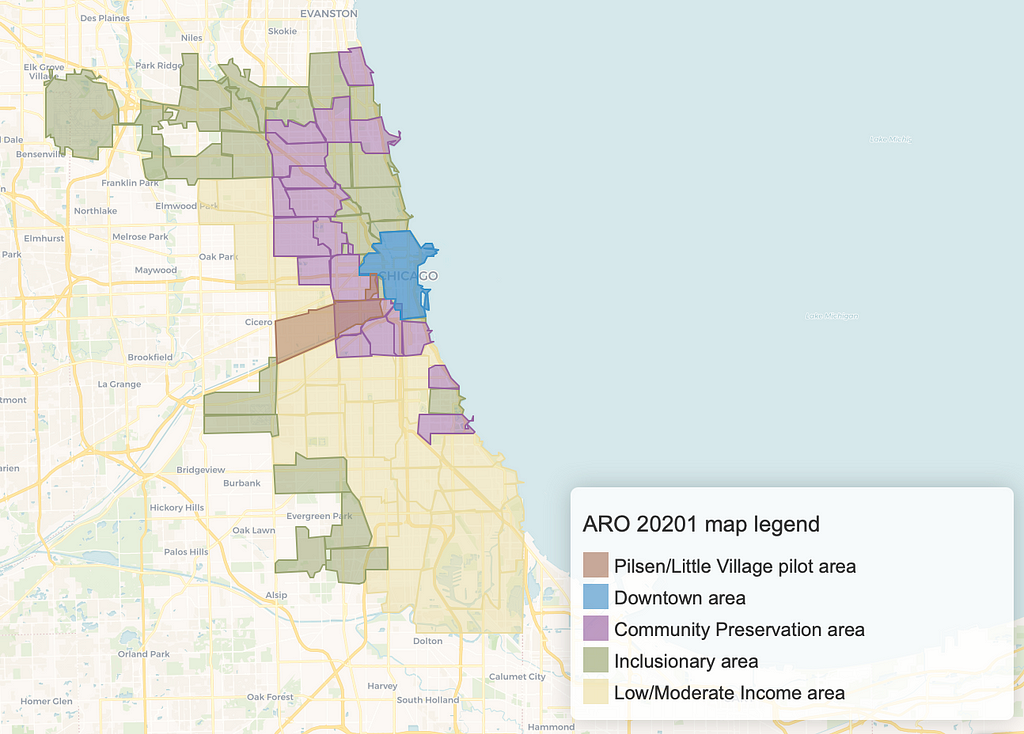
Our maps are vital to anyone who wants to develop new or substantially rehab existing housing in Chicago. The area type for a development area must be determined first in order to locate the associated rules.
- View our map of all ARO 2021 areas (a free Cityscape account is required)
- Look up any address in Chicago to see its area type and a small, focused ARO map of that area
- Using Property Finder, show properties that are within a specific ARO area
- Additionally, our API has been updated to return the name of the ARO area
Let’s get back to the rules
Thirdly, the basic provision in ARO 2015 that 10 percent (or more in some areas) of the dwelling units must be affordable has been replaced in ARO 2021 with requirements that are based on the area type. The 10 percent floor for rental developments is present only in Low-Moderate Income Areas.
The ARO 2021 rules have new flexibility with the minimum affordable units requirement: Not all units have to be rented at the same area median income (AMI) targets. Most developments that use the ARO 2015 rules must set the rents for the affordable units to target a household earning up to 60 percent of the AMI, but ARO 2021 rules allow a weighted average. This means that some units can be rented to households earning up to 40 percent of the AMI and other units can be rented to households earning up to 80 percent of the AMI as long as the average is 60 percent of the AMI.
Fourthly, more units have to be built. ARO 2015 required that 25 percent of the required affordable rental units had to be built on-site in low-moderate income areas and 25 percent built on-site or off-site in higher income and downtown areas. ARO 2021 on the other hand, requires 25 percent of the affordable rental units to be built on-site, and another 25 percent to be built on-site or off-site. The remaining balance can be covered by building units (on-site or off-site) or paying an in lieu fee; the in lieu fee can suffice for up to 50 percent of the required affordable rental units.
The rules for off-site units are quite different, too. ARO 2015 required off-site units, which wasn’t an option in low-moderate income areas, to be in a higher income area or downtown district, and within two miles of the development site. With ARO 2021, off-site units can be located within any Downtown, Inclusionary, or Community Preservation area. However, if the primary development site is in a Community Preservation area, the off-site units must be located within one-mile (but the off-site doesn’t have to be a CP area).
Additionally, if the primary development site is within a TOD or transit-served location (TSL), then the off-site units also have to be within a TOD. Every Address Snapshot lookup on Chicago Cityscape will determine TOD eligibility. (Note that the ordinance specifies that the off-site units are located in a “substantially comparable” transit-served location, which I take to mean that if primary site is near a CTA station then the planning department may not accept off-site units near a Metra station that isn’t on the Metra Electric line.)
In the Municipal Code of Chicago, find the rules at 2–44–085 (although the code hasn’t been updated as of publication).
Cityscape has the maps you need to locate where new ARO rules apply was originally published in Chicago Cityscape on Medium, where people are continuing the conversation by highlighting and responding to this story.
Other posts by Steven Vance full archive