Where the new state-enacted property tax incentive applies
Published on Sep. 21, 2021 by Steven Vance
Updated on Sep. 22, 2021
The Illinois government adopted a new incentive this summer intended to generate and maintain affordable housing across the state by offering significant reductions in a property’s assessed value. The legislation was co-developed and pushed by Preservation Compact, an coalition-like initiative housed at the Community Investment Corporation, a non-profit lender.
CIC will be presenting a webinar about this on 9/23/21 — see details below.
The incentive of HB 2621 is to attain a reduction in assessed value — something many property owners do every year when they “appeal their taxes” — as that can lead to significant reductions in property taxes.

Preservation Compact describes the legislation as having three incentive tiers: Tiers 1 and 2 will work across Illinois and offer different reductions in a property’s assessed value based on the number of units that are made affordable, and, if it’s an existing building, how much is invested in upgrading major “building systems”.
Tier 3 will apply only in downtown Chicago and certain Cook County suburbs — places with the least amount of affordable housing as a proportion of all housing — and has the greatest reduction in assessed value. Tier 3 also requires the greatest investment in systems upgrades for existing buildings. (The legislation allows county boards outside of Cook County to opt out.)’
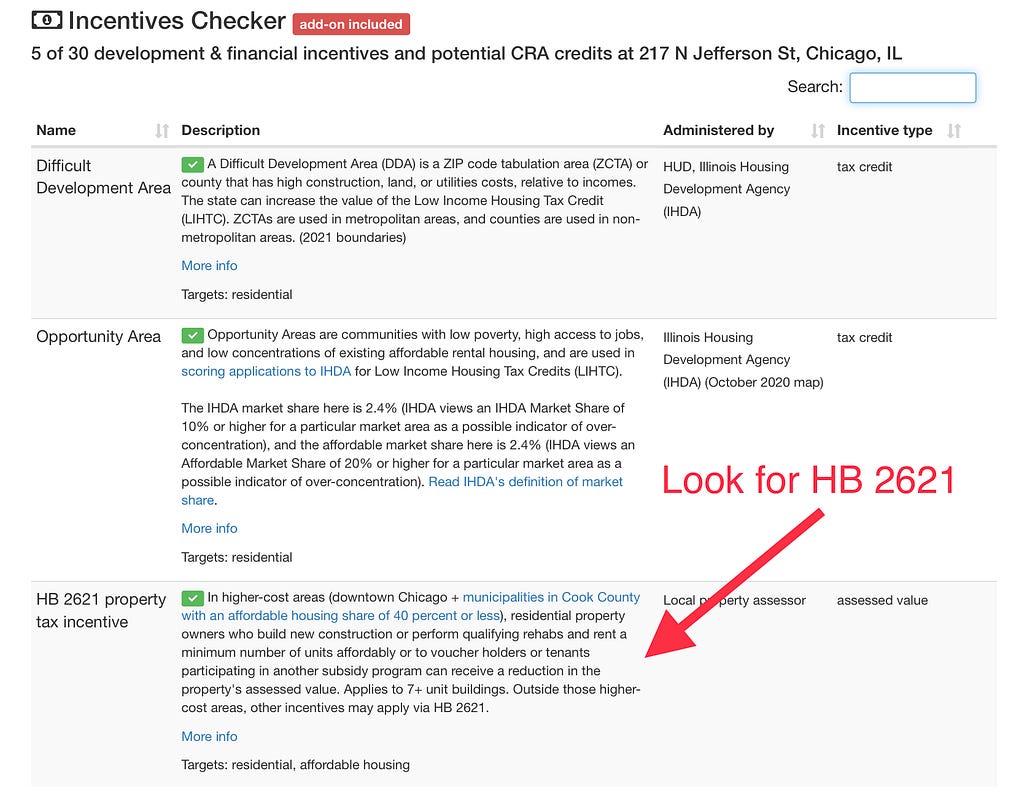
All three incentive tiers apply to buildings with seven or more units, and the program starts in 2022. Preservation Compact has a simple chart outlining the different affordability thresholds that correspond to different reductions in assessed value.
For our part, Chicago Cityscape has updated Incentives Checker to point out when an Address Snapshot one has looked up is within downtown Chicago (defined by the current “D” zoning districts and the areas in the Downtown Expansion Area), or in one of the eligible Cook County suburbs.
Affordability requirements
The general requirement is that to count as affordable units, they must be rented at a rate affordable to a household earning 60 percent of the area median income (which is currently $50,340 for a family of three).
Alternatively, a unit rented to a household which has a Housing Choice Voucher or a household participating in a state or local rental subsidy program (like Chicago’s Low Income Housing Trust Fund) would count as an affordable unit. Those two programs do not require a decrease in the rent; they’re designed to pay market rate for qualifying apartments.
Upcoming event
Need to know more? The Illinois Housing Council has arranged for Preservation Compact and Community Investment Corporation to present a webinar on Thursday, September 23, 2021. The presentation will cover:
- How the new relief is different from Cook County’s Class 9 program
- How projects completed since 2015 can retroactively qualify
- The new 80/20 incentive program available in downtown Chicago and low affordability communities
- Sharing recommendations with Assessor Kaegi on implementation
- Getting insight on the program from a diverse set property owners
Where the new state-enacted property tax incentive applies was originally published in Chicago Cityscape on Medium, where people are continuing the conversation by highlighting and responding to this story.
Other posts by Steven Vance full archive