A group of seven Chicago alders proposed an ordinance yesterday, called “Chicago Homes for All”, that would automatically approve a Planned Development project that included affordable housing in any ward where less than 10 percent of its housing units is designated affordable.
The ordinance doesn’t specify which wards meet that criteria, nor how to calculate the percentage of housing units in a ward that are “affordable designated housing.”
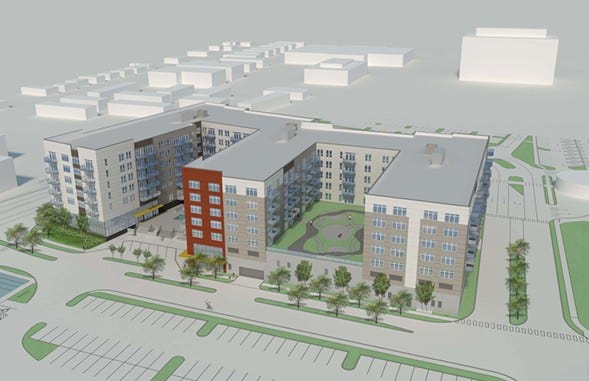
The goal would be to approve developments like Glenstar’s that has 300 apartments (30 of which are affordable) next to the Cumberland Blue Line station, which was denied at the City Council zoning committee this week.
A Planned Development is a process that the city zoning code requires in some instances (the site or proposed building is of a minimum square footage, or the number of units exceeds a threshold), and is elective in other instances. To use the elective PD procedures, the site needs to be at least 21,875 square feet (seven standard city lots) and meet one of four criteria.
The proposed ordinance, which only applies to proposed Planned Developments, reads exactly like one of the strategies in Metropolitan Planning Council’s anti-segregation report — Our Equitable Future — to “Lessen local control over affordable housing decisions”. The proposed ordinance states:
To reduce the entrenched segregation of Chicago’s stock of affordable family housing and ensure the City complies with its duty to affirmatively further fair housing, the Chicago Plan Commission and Committee on Zoning, Landmarks and Building Standards shall approve a Planned Unit Development (PUD) Application which includes affordable family housing units in wards where less than 10% of the housing stock within the ward is currently offered as dedicated affordable housing, subject to the following approval criteria and decision making process:
The criteria, which can only be refuted with “substantial evidence, are:
- not have an adverse affect on traffic flow or parking
- generate appropriate noise levels
- have a quality of exterior appearance similar to other residences
- complies with all other city standards
It’s a kind of “triggered” or “automatic” zoning approval.
In California, senate bill 35 accelerates approvals if projects meet certain affordable criteria. Recently, in Berkeley, a developer finally got a project approved despite local opposition that delayed it for five years because 50 percent of the units will be affordable.
One issue with the proposal is that the projects aren’t guaranteed to create a good minimum level of affordable units themselves. Presumably, the “complies with all other city standards” clause requires that the projects comply with the Affordable Requirements Ordinance (ARO). That means 2.5 percent of units must be affordable and on-site, and 7.5 percent of units can be “bought out” with an in-lieu fee. If it’s in one of the ARO pilot areas, the ratios are higher, and the in-lieu fees are not allowed (but not all units have to be built on site).
To use the Glenstar proposal as an example, they are building 300 units. Eight of them have to be built on site. While that’s eight more affordable apartments than the 41st Ward currently has, the proposed ordinance doesn’t change any of the rules to require more from property owners — more affordable units, less parking, etc. — who might take advantage of the expedited process, which could be seen as a giveaway to developers.
This would surely resolve the issue of “aldermanic prerogative”, which needlessly kills projects and wastes money (making housing more expensive), but with the way this ordinance is written a developer could propose a Planned Development, get it approved within six months, without having to do anything “extra”.