Most land near the Obama Presidential Center is tied up
The Obama Presidential Center is set to be built in the center-west part of Jackson Park, southwest of the Museum of Science and Industry, and southeast of the Midway Plaisance and the majority of the University of Chicago campus. The Chicago Plan Commission will vote to approve the Obama Foundation’s plans this month.
Something President Barack Obama said this week about development it will presumably spur has got me thinking about the possibility of such ancillary development.
Blair Kamin wrote in the Chicago Tribune:
He [Obama] described a transformed neighborhood, with visitors checking out a restaurant or an art studio across Stony Island Avenue from the center. Yet Obama also revealed his pragmatic side, promising the center would supercharge areas hit by decades of disinvestment, while acknowledging fears that such growth will force out low-income residents.
Kamin wrote a lot more after this second paragraph but I only need to talk about the first sentence, “visitors checking out a restaurant or an art studio across Stony Island Avenue from the center.”
Unless the zoning and land uses are drastically changed, or a housing development is demolished or modified, what Obama is suggesting people could do after a visit is impossible.
What’s across the street is Jackson Park Terrace, an affordable housing development with 312 homes, and parking.
Review the zoning map and you’ll see that all of the land across from the center’s proposed site is tied up as a Planned Development, residential, and the Hyde Park Academy high school.
Planned Developments (PD) are a special kind of zoning district where all development is designed or completed under a strict agreement between its property developer and city planners.
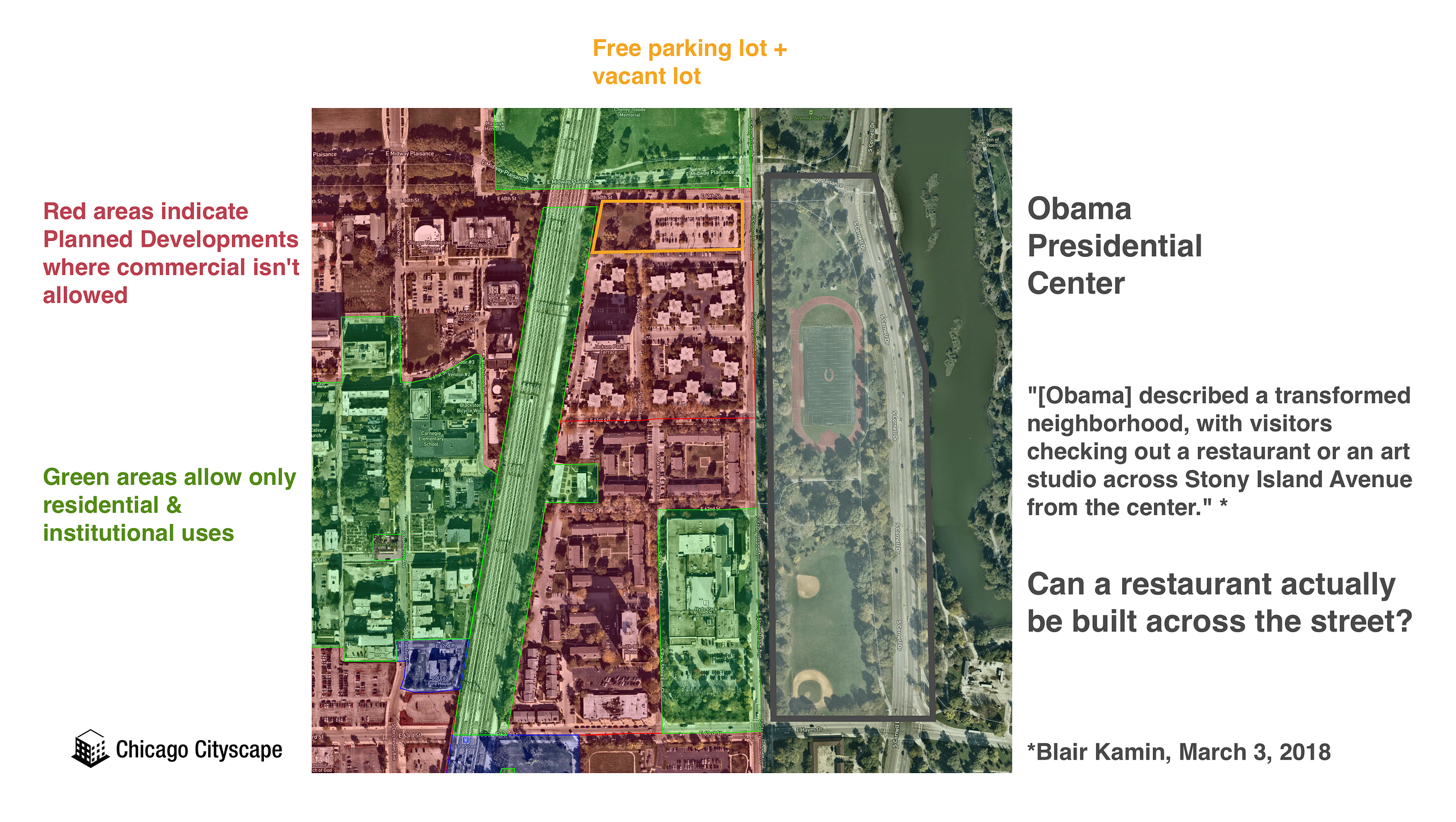
“PD 43” (map) is across the the street; its “Subarea J” has hundreds of homes as well as a 152-space car parking lot — currently free for anyone to use — next to a vacant lot.
The PD agreement — originally adopted in 1966 and amended a dozen times since then — says that Subarea J must have a minimum of 308 car parking spaces and up to 20,000 square feet of buildings for “convenience businesses and related other uses”.
That limit on commercial uses is quite small, representing an area that’s barely larger than a Walgreens, or 8-10 street front businesses.
The city’s planning department, the Chicago Plan Commission, and the University of Chicago — which is a party to the PD agreement — would have to collaborate to amend the PD and allow more space for businesses and reduce the minimum car parking requirement.
I haven’t heard of any news in the media that Chicago Department of Planning & Development plans to undertake a review of land use allowances outside of the OPC.