What’s good in the neighborhood?
Published on Mar. 28, 2023 by Steven Vance
Updated on Mar. 29, 2023
Chicago Cityscape has compiled several data sources — over 150, to be more precise — to help real estate brokers, community development corporations, and neighborhood stewards, highlight local assets and reasons for investment in the Chicago neighborhoods they represent.
We’ve collected these datasets because we believe there are multiple ways to write a narrative about why people choose to live or stay living here.
This article will discuss how to access and incorporate data from seven datasets, tools, and features on Chicago Cityscape into your newsletters, social media posts, offering memorandums, and even fundraising appeals.
- Business activity
- Public sector investments
- Developments gallery
- Construction activity
- Proposed projects
- Incentives
- Development opportunities

Getting started
For every data source you want to incorporate, you’ll need to define your area of interest and select its Place Report. There are thousands of Place Reports in Chicago. Search for a ward, ZIP code, community area, business district or SSA, or draw your own Personal Place.
- Search for a specific place in the search bar, or browse for it using Places Explorer
- Use one of our sample Place Reports (these are unlocked for everyone)
- Draw your own Personal Place to get a Place Report
We’ll be using information about the Auburn Gresham community area in this article.
By the end of the article you’ll see that all kinds of things are happening in Auburn Gresham. Research using Chicago Cityscape and you’ll see that there’s some kind of news, development, public investment, or business activity in every community.
1. Business activity
Assess the amount of new businesses that are coming into a community and which ones are renewing their licenses. Chicago Cityscape’s “Businesses Snapshot” makes this easy for you.
At the top, it shows the number of businesses newly licensed in the past seven days. This helps many of our members who run SSAs, Chambers, and Neighborhood Business Development Centers. These groups who are required to reach out to new business owners to extend marketing and other resources.
You can also see the total number of specific business types in an area compared to other parts of the city. This is useful if there’s a need to count the prevalence or dearth of specific businesses. (This works best when analyzing places of a type that cover the entire city, like community areas, wards, and ZIP codes.)

In the Auburn Gresham Businesses Snapshot, for example, there are 62 businesses that have the “Retail Sales of Perishable Foods” license compared to an average of 71.5 businesses across all 77 community areas.
2. Public sector investments
Public sector investments can play a critical role in shaping the economic landscape of a community. With Chicago Cityscape, you can easily identify where the city is investing resources in a given area.
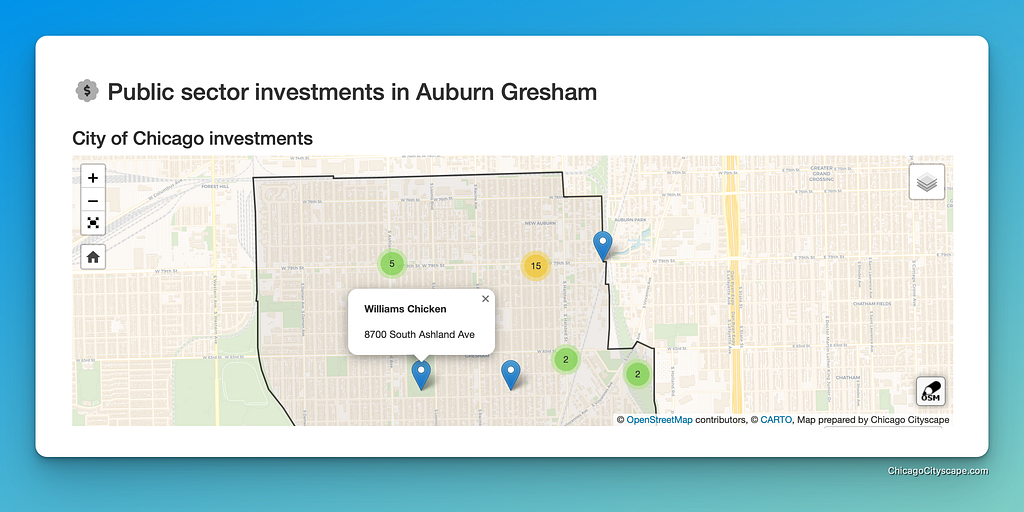
Take note of any investments in the area, as these may indicate growth and development opportunities. For example, TIF investments may be used to support infrastructure and building improvements, while SBIF investments may be used to support local businesses.
Consider how these investments may impact the local economy and community development, and which investments — including one of yours — could follow.
3. Developments gallery
Too often we hear of the negative news in Chicago neighborhoods. To help shape a fuller narrative, Chicago Cityscape aggregates articles about community, economic, and real estate development to show where there’s positive investment happening.

In addition to news and images of proposed projects that are requesting a zoning change, this gallery is also full of proposals that have made it at least a step beyond ideation. For example, a small business may have received a grant but this project hasn’t yet received a building permit and won’t appear in the Building Permits Browser.
Or, a community-based organization is going to acquire city-owned land and the Community Development Commission is about to authorize the property transfer — it will take months before this disposition is reflected in our primary datasets, so we add it to the developments gallery.
4. Construction activity
Now it’s easy to see every construction project with Chicago Cityscape’s Building Permits Browser. You can see where the projects are happening, read what’s being built, and learn who is behind it. This information can help you identify areas of growth or development and track changes in the local real estate market.
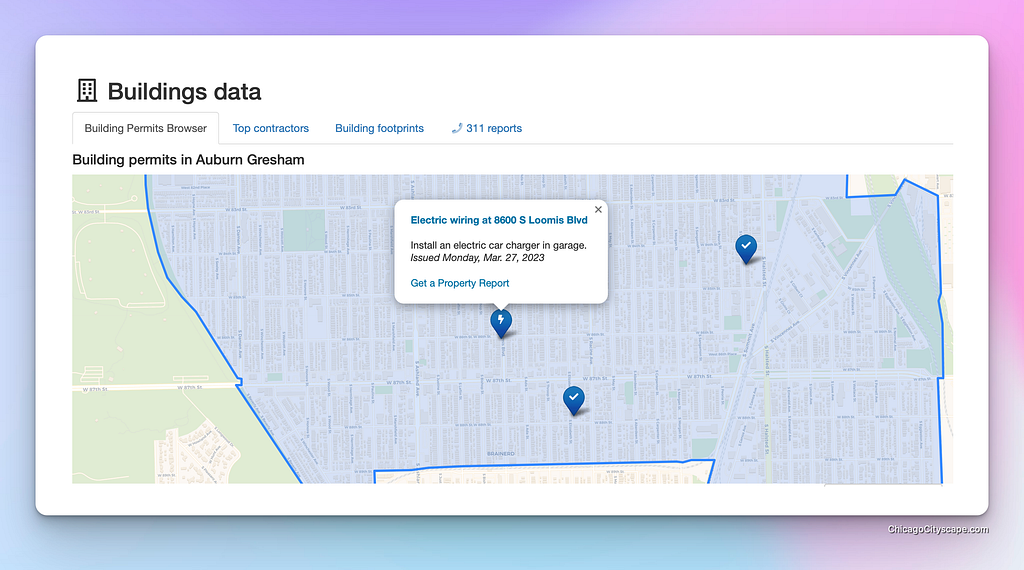
Take note of any projects that are relevant to your market analysis, such as new construction and renovation projects (or new at-home electric vehicle charges, as shown above).
You can also export the data to a spreadsheet by selecting the “Export” button at the bottom of the screen. Repeat the process for other areas or neighborhoods until you have gathered all the information you need for your analysis.
5. Proposed projects
The Proposed Projects tool in Chicago Cityscape is a powerful tool for anyone interested in understanding future development trends of a particular community or area. This tool provides information on every development that requires approval from City Council or Chicago Planning Commission.
There is a citywide map of Proposed Projects and one in each Place Report.
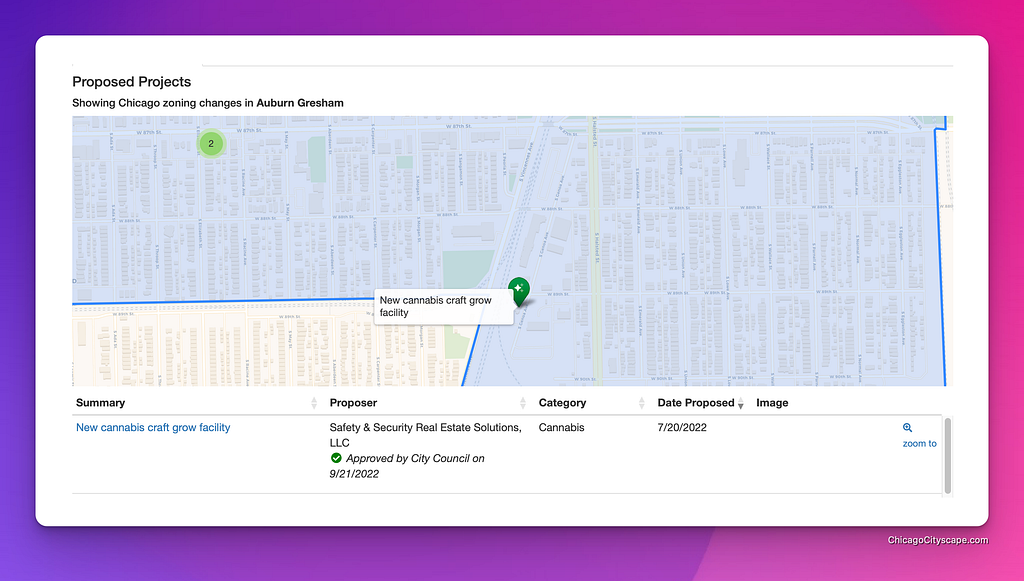
Once you have identified a proposed project of interest, you can review its scope of work, get contact information, and see the approval stage.
You can use the tool to identify areas that are experiencing a high volume of proposed development, which may indicate a growing market or will have essential community-oriented investments.
6. Available incentives
The Incentives Checker tool in Chicago Cityscape is a valuable resource for anyone interested in uncovering available incentives for a potential development, business start-up, or property investment. This tool provides information on over 30 incentives from local, county, state, and federal governments.
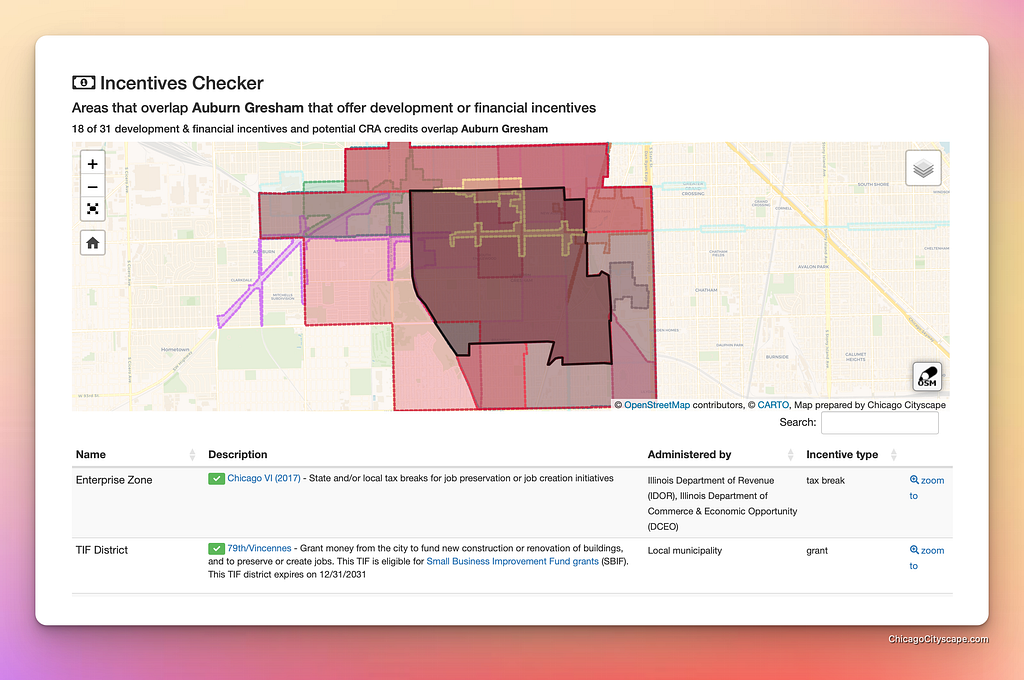
We provide this information in every Place Report and Property Report. In Auburn Gresham, our system checked for 31 incentives and found 18 incentives that overlap the community area. This includes several TIF districts, and one of our favorites, an Enterprise Zone, which can exempt construction materials from state sales tax (which is 6.25 percent).
Our members who support local businesses can use it for their market analysis as a way to attract new and relocated businesses. Incentives Checker helps identify incentives that can help offset costs or provide other benefits, such as tax credits or reduced regulatory burdens. If you are a real estate investor or broker, you can use the tool to identify incentives that can make a particular property more attractive to potential buyers or tenants.
7. Development opportunities
Within every Cook County-based Place Report is Property Finder, one of our premier tools. There are over 900,000 properties in Chicago and Property Finder’s filters are essential to conducting a market analysis that highlights where the development opportunities are.
Property Finder is a powerful tool that allows users to unlock the potential of empty parcels and vacant buildings in their neighborhoods. By providing comprehensive data on each property’s allowed uses, housing capacity, and available incentives, and historical data, users can explore a wide range of possibilities for development.
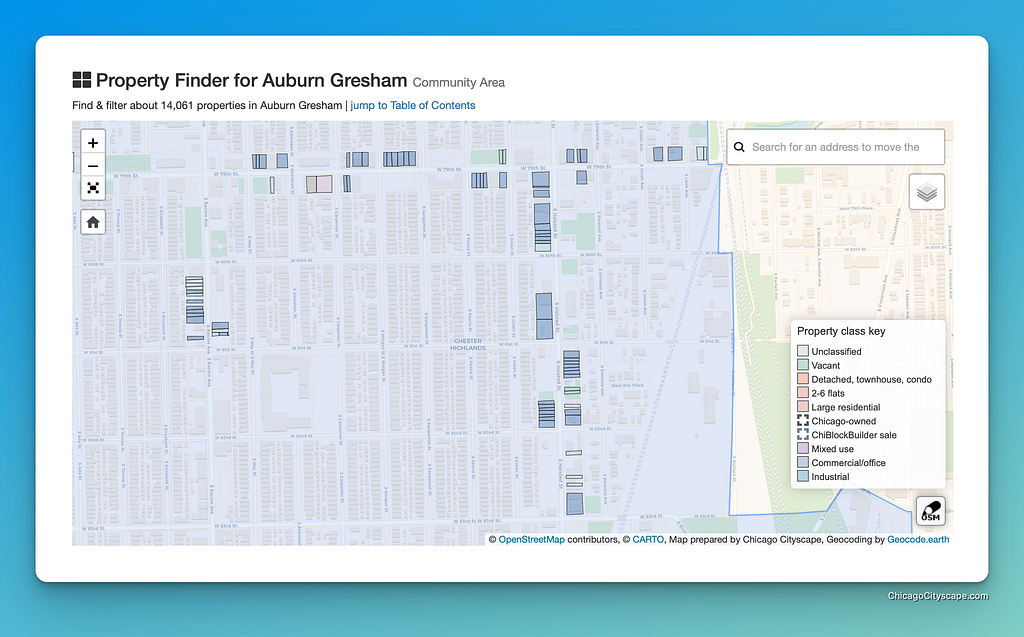
The filters range from “one click” to layered approaches, depending on the amount of time you can devote to finding and analyzing properties in bulk. For example, Property Finder can point out all of the properties owned by the City of Chicago or in the Cook County Land Bank Authority’s inventory.
Separately, Property Finder can locate low-intensity land uses — like parking lots — in areas zoned for higher-density and mixed-use development, with “one click”.
What’s next
Sign up and start a free 14-day trial, no credit card needed.
What’s good in the neighborhood? was originally published in Chicago Cityscape’s Blog on Medium, where people are continuing the conversation by highlighting and responding to this story.
Other posts by Steven Vance full archive